 Barry Forshaw
Covering on Blu-ray Choice: CRONOS, Guillermo del Toro, director/BFI, SHORT NIGHT OF GLASS DOLLS, Aldo Lado, director/88 Films,TWO BY CRAWFORD, TWO BY COOPER, various directors/Indicator, THE BROOD, & SCANNERS, David Cronenberg, director/Second Sight, CRUISING, William Friedkin, director/Arrow, SIRK IN GERMANY, Douglas Sirk, director/Eureka, Y,OJIMBO & SANJURO, Akira Kurosawa, director/BFI, DARK NIGHT OF THE SCARECROW, Frank De Felitta, director/88 Films, JE T’AIME, JE T’AIME, Alain Resnais, director/Radiance Films, IN A YEAR OF 13 MOONS, Rainer Werner Fassbinder/STUDIOCANAL, CASTAWAY, Nicolas Roeg, director/88 Films, DON’T TORTURE A DUCKLING, Lucio Fulci, director/Arrow, EYEBALL, Umberto Lenzi/88 etc.
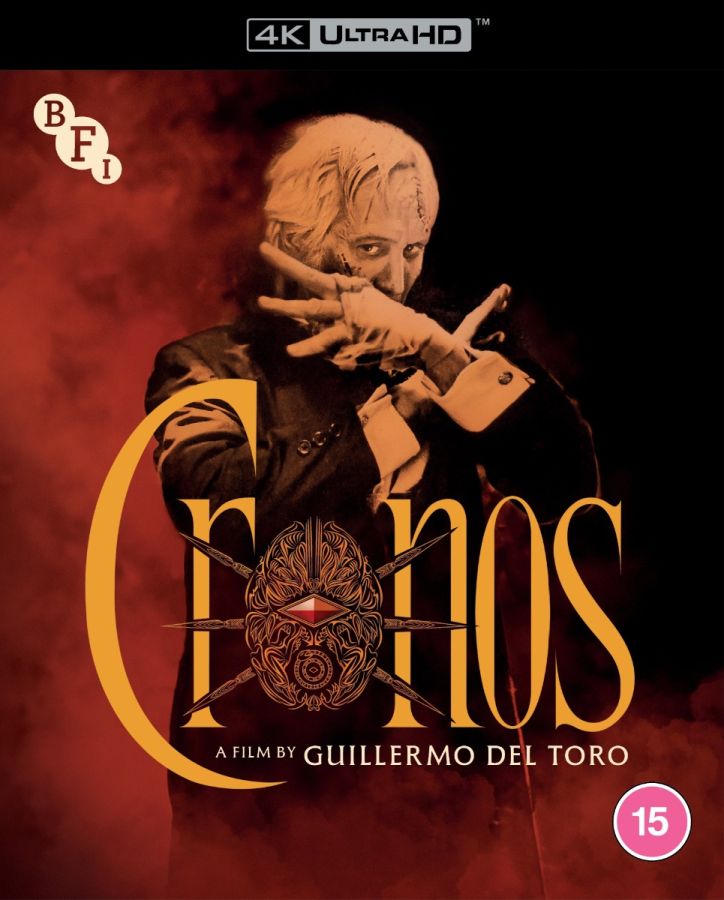
CRONOS, Guillermo del Toro, director/BFI
I enjoyed contributing a booklet essay for this splendid new restoration of Guillermo del Toro’s Cronos, writing about vampire cinema of the 1990s (This was a decade that pointed forward to other creative developments in the vampire genre). This new 4K restoration of del Toro’s remarkable debut film reminds us that Cronos is now regarded as one of the most important Mexican horror films. It stars the magnetic Federico Luppi and Ron Perlman (who both went on to become regular alumni in the director’s films). This restoration, available in Limited Edition 4K UHD and Blu-ray sets, has been personally approved by the director.
SHORT NIGHT OF GLASS DOLLS, Aldo Lado, director/88 Films
Any film starring Ingmar Bergman’s muse Ingrid Thulin is worth any discerning viewer’s attention, but it’s particularly unusual to find her in the context of an Italian giallo (or something near the genre). The original choice for the lead in Aldo Lado’s film was the inexpressive Terence Hill, but the director was lucky to sign the somewhat more flexible Jean Sorel, who acquits himself well in this supernatural-adjacent tale that stirs in elements of satanic horror, detective story and even a political strand. As is often the case with this director, the results are imaginative. In a complex scenario, an ageing elite vampirises lives of the young. The impressive cast delivers complex well-rounded performances. When the corpse of American journo Gregory Moore (Sorel) is found in the Malá Strana area of Prague, an autopsy is scheduled. But there is a problem: Gregory is still alive and is frozen in a death-like state. With a score from the great Ennio Morricone, this is a vintage semi-giallo.
TWO BY CRAWFORD, TWO BY COOPER, various directors/Indicator
Is there a Blu-ray company active in the UK to which cinéastes owe a debt more than the always enterprising Indicator label? Throwing its net across a dizzying array of genres, each entry from the company can be guaranteed to provide an entrée into the byways of cinema from the recent past to much earlier eras. That’s the case here with this duo of duos featuring two of the most revered stars of the Golden Age: Joan Crawford (gloriously relishing her controlling matriarch figures in two films, Harriet Craig and Queen Bee) and the charismatic Gary Cooper in films that showcase his fruitful collaboration with the director Henry Hathaway. The Cooper films are the durable The Lives of a Bengal Lancer, and the fey Peter Ibbetson, co-starring Ann Harding and Ida Lupino. This latter film was a favourite of the Surrealists, being highly praised by André Breton and Luis Buñuel.
THE BROOD, & SCANNERS, David Cronenberg, director/Second Sight
Two groundbreaking earlier efforts from the undisputed maestro of Canadian body horror David Cronenberg. The Brood, one of Cronenberg’s most provocative (and disturbing) outings, merits this long-awaited new UK Blu-ray makeover courtesy of Second Sight Films. This early piece from the director stars a typically intense Oliver Reed along with Samantha Eggar and still packs a punch. As for its companion piece – well, how does the once-groundbreaking Scanners look these days? In terms of its cinematography, the film has never looked better than in this shining incarnation – and the customarily mesmeric performance of Patrick McGoohan, unsympathetic as he usually is in his film work, still rivets the attention. Still problematic, however, is the underwhelming performance of Steven Lack in the central role; he is an appreciable actor, but uncharismatic in a plot that crucially requires such qualities. Scanners, however, remains one of the most iconic horror films of the eighties from Cronenberg.
CRUISING, William Friedkin, director/Arrow
In recent decades, movies have had something of a post-modern, self-referential take on the erotic film genre, such as James Franco’s Interior. Leather Bar (2013), which addresses the famous missing sequence (cut to avoid an ‘X’ rating) from William Friedkin’s highly controversial gay serial killer film Cruising (1980, with Al Pacino); the original film had occasioned something of a gay backlash as it was considered that it did not treat the leather/S&M scene – or its gay clientele – sympathetically. This exemplary sprucing up of Friedkin’s film on a 2-disc Limited Edition 4K UHD is finally restored to its long-unavailable original theatrical version in 4K and demands a reappraisal. Taking the premise and title from reporter Gerald Walker’s novel, Cruising was the subject of considerable controversy at the time of its release and remains challenging to this day, with Pacino’s tormented, ambiguous lead performance as its focus. We are given a slew of new bonus features, including a 120-page perfect-bound collector’s book.
SIRK IN GERMANY, Douglas Sirk, director/Eureka
The days when the so-called women’s films of the 1950s were held in low esteem now seem very distant, and several of the primary exponents of the genre are now celebrated as masters of their craft, rendering the glossy melodramas as complex and provocative interrogations of the very genre to which they belong. One of these directors, Delmer Daves, is now perhaps held in higher esteem for his westerns, but the king of the genre was unquestionably the German expat Douglas Sirk, and those who have admired his early work from German period will relish this set. This collection is an absolute treasure trove, and an almost perfect example of how useful the Blu-ray revolution has proved (and continues to prove) in unearthing treasures of the past.
HARLEQUIN, Simon Wincer, director/88 Films
An enigmatic faith healer – who appears to possess genuine magical powers – and a political fixer vie for influence over a senator and his family. This outing from director Simon Wincer is bolstered by the presence of two reliable British male stars of the day, Robert Powell and David Hemmings (the latter older and plumper than in his heyday),
Oz supernaturalism (possibly!) orchestrated by director Simon Wincer.
GOLEM, Piotr Szulkin, director/Second Run
This is an adaptation of the Golem Legend unlike any you will ever have seen. Second Run present the UK Blu-ray premiere of Piotr Szulkin’s Golem (1979). Szulkin (1950 – 2018) was a filmmaker of notably imaginative films, and Golem was his iconoclastic debut. A cynical satire of Communist Poland in the late 1970s, Szulkin’s Kafkaesque science-fiction allegory has a variety of modern-day resonances, and the set also includes premieres on Blu-ray of a selection of Piotr Szulkin’s early short film works.
YOJIMBO & SANJURO, Akira Kurosawa, director/BFI
For admirers of classic cinema, the release of two classics by the great Akira Kurosawa will be the sheerest catnip, showcasing the director’s perfect synthesis of arthouse sensibility and action cinema. Yojimbo is an early iconic movie that Sergio Leone in A Fistful of Dollars plundered for its plot (a man of violence, servant of two corrupt masters, plays each one against the other, assuring their destruction – a plot, in fact, that Kurosawa himself had lifted from Dashiell Hammett’s Red Harvest). Its sequel, Sanjuro (1962), also starred Toshiro Mifune, but is more light-hearted than its predecessor, although equally diverting. Included is a newly filmed discussion by Japanese film expert Jasper Sharp and a 2002 documentary on each film in which they are examined in detail, along with more special features.
NOMAD, MY HEART IS THAT ETERNAL ROSE, Patrick Tam, director/Radiance Films
Those with a taste for international cinema will be aware of such talented directors as Patrick Tam — particularly as more of his work is becoming available in the silver disc medium. An icon of the Hong Kong New Wave and mentor to Wong Kar-wai, Tam worked with icons including Tony Leung (In the Mood for Love), Leslie Cheung (Days of Being Wild), Kenny Bee (Armour of God) and others in these two unusual outings.
THE TEXAS CHAINSAW MASSACRE 2, Tobe Hooper, director/Arrow
Controversial in a very different way from its macabre predecessor, Tobe Hooper’s second trip into chainsaw-wielding territory once again features the hulking killer Leatherface in the truly bonkers (and much bloodier) The Texas Chainsaw Massacre 2. Featuring a typically scenery-chewing performance from Dennis Hopper as a vengeful sheriff, this 4K restoration sports three commentaries, and is festooned with bonus features. The new issue includes limited edition packaging, a booklet featuring new writing, a double-sided fold-out poster, two collectable cards and three double-sided postcards. The release is available on Limited Edition 4K UHD and Limited Edition Blu-ray.
MIRACLES, Jackie Chan, director/88 Films
Frank Capra ‘s soft centred 1960s drama Pocketful of Miracles would probably not play too well to modern audiences (apart from those with a taste for nostalgia), but this reworking of the theme has a nicely acerbic modern edge and is further proof that there is more to the actor Jackie Chan than simply risking his own life (and that of his stuntmen) in a series of hyperactive thrillers. Directed by the actor himself, the film has optimistic Gwok Zan-Waa (Jackie Chan) arrive in Hong Kong, quickly finding himself impoverished. That is, until a serendipitous encounter with a rose seller (Gua Ah-Leh) leads to his inadvertent appointment as boss of a local gang. Remastered in 4K UHD with Dolby Vision and featuring both the Theatrical and Export Versions.
DARK NIGHT OF THE SCARECROW, Frank De Felitta, director/88 Films
if you’re looking for a classic example of the ‘sleeper’ film – the kind of piece whose reputation grows throughout the years until a film acquires a cult reputation, you need look no farther than Frank De Felitta’s remarkable horror entry which efficiently delivers its pulse-raising suspense as the eponymous scarecrow cuts a murderous swathe through its victims. It’s a film which fully justifies its sleeper reputation.
JE T’AIME, JE T’AIME, Alain Resnais, director/Radiance Films
Something of a rarity from cult arthouse director Alain Resnais, this is the film that demonstrated his liking for science fiction (there was a period when he was planning to make a film with Marvel’s Stan Lee). Claude Rich plays a young man who, after an attempted suicide, is persuaded by scientists to participate in a time travel experiment for short periods. The opening lines, from TS Eliot’s Burnt Norton, ‘Time present and time past are both perhaps present in time future’ give an indication of the intriguing direction Resnais takes in this film. It’s challenging fare, perhaps (and the science fiction elements are rather peripheral), but it’s well worth the effort.
IN A YEAR OF 13 MOONS, Rainer Werner Fassbinder/STUDIOCANAL
The late Rainer Werner Fassbinder here eschewed the kind of accessible melodrama inspired by Douglas Sirk for this provocative drama involving the now pertinent theme of sex change. Many of the director’s recurrent themes are to be found here for those prepared to winkle them out. It’s one of Fassbender’s most committed films, made in response to the suicide of Fassbinder’s lover Armin Meier, It’s perhaps the director’s most personal film.
AN AMOROUS WOMAN OF TANG DYNASTY, Eddie Fong Ling-ching, director/88 Films
The end was in sight for the Hong Kong’s famous Shaw Brothers studio, but this visually stunning entry was a perfect last hurrah. – a visually ravishing and erotically charged story of a free-spirited female poet Yu (Patricia Ha) who, frustrated by the conservative mores of the day, refuses to behave in the ‘proper’ way.
CASTAWAY, Nicolas Roeg, director/88 Films
One of Michael Powell’s later films, Age of Consent, featured an often nude (and youthful) Helen Mirren, gazed at admiringly by an older actor (in that case, James Mason), and cult director Nicolas Roeg repeated that strategy with Castaway; in this film, the zaftig young woman is Amanda Donohue, and the older man — similarly denied sexual favours – is a plump Oliver Reed. This is an exemplary presentation of the film; Roeg’s visuals come up eye-poppingly.
A TOUCH OF LOVE, Waris Hussein, director/ STUDIOCANAL
Adapted from the novel The Millstone by Margaret Drabble, this affecting 1969 British drama is directed by Emmy award-winning Waris Hussein and adapted by Margaret Drabble from her novel ‘The Millstone’. The film stars Oscar-winner Sandy Dennis and a youthful Ian McKellen Special features include new interviews with Waris Hussein, Margaret Drabble and Ian McKellen.
DON’T TORTURE A DUCKLING, Lucio Fulci, director/Arrow
Fulci aficionados once sought out his lesser-known films in order to fill the gaps in their viewing lists — and the discovery of the little-seen (in the UK) Don’t Torture a Duckling (co-written with Roberto Gianviti and Gianfranco Clerici) occasioned some very disparate responses. Before the restoration here, it was only available in compromised form: most viewers would only have seen the dubbed version rather than the one with the more authentic Italian soundtrack, even though that was also post-synched. Both are on offer here, although the Italian track with subtitles does more justice to Fulci’s vision. Those expecting a giallo (glossy murders in upscale apartments) will be disappointed, even though, ironically, giallo ingredients are to be found in what at times looks like one of Neorealist director Francesco Rosi’s gritty rural dramas. Don’t Torture a Duckling deals with the murders of young boys by a black-gloved assassin. The latter is giallo reference number one – the ubiquity of leather gloves on killers is a fondly loved cliché for admirers of the genre. However, the giallo elements of the film are really represented in only two of the characters, one of whom is the debauched society woman played by Barbara Bouchet (a stable actress of the genre).
DRESSED TO KILL, Brian de Palma, director/Arrow
Brian DePalma’s most celebrated Hitchcock homage. Starring Michael Caine alongside de Palma regular Nancy Allen (with Angie Dickenson doing Janet Leigh/Kim Novak duty), Dressed to Kill has been restored and is issued here in uncut form. Arrow’s deluxe edition of the film boasts (as usual) an exclusive selection of special features and bonus material.. Upon its release in 1980, Brian De Palma’s thriller, starring Michael Caine and Angie Dickinson, was as acclaimed for its stylish set-pieces and lush Pino Donaggio score as it was condemned for its sexual explicitness – but the glee with which the writer/director turns this material inside out is completely infectious, as he delves deep inside the troubled psyches of his characters to undermine expectations at every turn.
THE TERMINAL MAN, Mike Hodges, director/Arrow
Mike Hodges’ The Terminal Man was certainly due for a reappraisal. To say that the much-acclaimed Get Carter (1971) was something of an albatross round the neck of the director is only partially true. Certainly Hodges, who was born in Bristol, never quite matched the cult success of that film, but he nevertheless created a corpus of films that are full of accomplishment and imagination. He spoke several times to this writer about his neglected dark science fiction piece which sports a multifaceted performance by George Segal. It’s an unsettling slow-burn film.
EYEBALL Deluxe Limited Edition (4K/Blu-ray dual format, Blu-ray and 4K release), Umberto Lenzi, director/88
While the names of directors such as Bava, Argento and Martino have acquired the patina of a certain respectability, that of Umberto Lenzi has more notoriety attached to it, notably for such films as Eaten Alive and Cannibal Ferox, grisly entries in the cannibal stakes that so upset the censors back in the 1980s. But while Lenzi’s career remained hit and miss, there is much to be said for his work, and the re-emergence of such films as The Killer Must Kill Again, a tortuous giallo played out with real gusto, has reawakened interest in his immensely prolific career. Also made with a craftsmanlike skill was Gatti Rossi in un Labirinto di Vetro (Eyeball, 1974), a lively outing that approaches the achievement of the uncrowned king of the giallo, Dario Argento.
THE REBEL & THE PUNCH AND JUDY MAN, various directors/STUDIOCANAL
To mark the centenary in 2024 of the birth of British comedy legend, Tony Hancock, a welcome release for the actor’s two solo films The Rebel and The Punch and Judy Man. Notable for being Hancock’s only starring roles on film, the two comedies feature new extras material and as part of company’s Vintage Classics collection. Hancock aficionados need not hesitate – and those new to the comedian will be able to see why there remains such a cult following for Hack/
HARDBOILED, Alain Corneau, director/Radiance Films
The UK boasts a highly enterprising selection of boutique Blu-ray labels, and one of the prime contributors to this quiet revolution is the Radiance label under the stewardship of Francesco Simeoni. Some of the strongest previous projects have included crime films from around the world (to which this writer has contributed), and the new set, Hardboiled, containing three films by Alain Corneau, is unmissable. The rare films collected here are cherishable indeed, sporting a particularly Gallic version of the Noir idiom, and perhaps the jewels in the crown are the performances by the late Yves Montand. His career in English-speaking cinema was respectable enough, but didn’t really hint at the full extent of his abilities – something that Corneau brings into full focus. All the films are presented for the first time on Blu-ray. In Police Python 357, Montand plays a cop implicated in the death of his lover, while Série noire is an adaptation of Jim Thompson’s A Hell of a Woman set in the banlieues of Paris. Choice of Arms has Montand joining a stellar cast, including Catherine Deneuve and a menacing Gerard Depardieu.
MABUSE LIVES! DR MABUSE AT CCC: 1960–1964, various directors/ Eureka Entertainment
The final films of great directors in the twilight of their careers are always fascinating – for a variety of reasons. Hitchcock ended his amazing series of films with a pleasing (if minor) comedy thriller, Family Plot, but another expat European director who worked in Hollywood wrote ‘finis’ with something quite different. The great Fritz Lang had created in his early German films the sinister, all-seeing master criminal Dr Mabuse, and on his return to his native country after a successful career in America, Lang was persuaded (against his better judgement) to revisit the territory of a monstrous criminal seen through a vaguely science-fiction prism. Ironically, the SF aspects of the film, so striking back in 1960, are now part of our world of the present – such as the ever present electronic surveillance. But if Lang was reluctant to make the film, he still let loose his considerable talents on the property, creating a delirious thriller full of outrageous and deliberately unlikely situations. With the larger-than-life German character actor Gert Frobe (most famous for his Bond stint as Goldfinger) as the eccentric detective on the trail of the master criminal Mabuse, we’re assured of our money’s worth. Much was made years ago of how the film foreshadowed elements in the James Bond films (leaving aside Gert Frobe!), and that is still one of its points of interest today.
A CERTAIN KILLER & A KILLER’S KEY, Kazuo Mori, director/Arrow
Given that the genre of the hitman thriller is so desperately overcrowded, the viewer could be forgiven for being more inclined to pick and choose these days – particularly as much tempting material is making an appearance in the Blu-ray idiom. So if your palette is primed for something different, here are two films which can be confidently recommend for their stylishness and energy (not to mention their finely tuned performances). A Certain Killer and A Killer’s Key are a duo of stylish hitman thrillers directed by Kazuo Mori and starring the charismatic Raizō Ichikawa and shot by one of Japan’s most celebrated cinematographers, Kazuo Miyagawa (who lensed Kurosawa’s Rashomon), these striking crime dramas arrive with new commentaries and introductions.
THE LAST STOP IN YUMA COUNTY, Francis Galluppi, director/Arrow
Does it matter that the influence of the director Quentin Tarantino is all over this lively crime piece, written and directed by Francis Galluppi? If you’re not worried by the overt inspiration, you will experience a very diverting time in this clever and unusual piece which reads like a tight chamber piece owing some kind of debt (albeit, perhaps, an unconscious one) to the celebrated Twilight Zone episode, ‘Will the Real Martian Please Stand up’ – not that there are any aliens on view in this piece. Strong performances are served up by (among others), genre favourite Barbara Crampton, The Last Stop in Yuma County is a diverting crime dramas and an examinations of choice.
RULERS OF THE CITY, Fernando di Leo, director/ Radiance Films
Generally speaking, the treatment in the cinema of the scourge of the Mafia was notably more astringent in the genre in Italy than in American films, where — despite the brutality of the organisation — there was a grudging respect accorded to the killers for their professionalism and old world courtesy (codes of honour operated even when they were cutting the throats of their victims). Such Italian directors as Stelvio Massi and Antonio Margheriti presented an unvarnished, rigorously unsentimental view of Mafia activity in their films, with endemic corruption the engine by which the organisation was able to maintain its relentless grip. Among the best directors in the genre is the talented Fernando di Leo, whose Rulers of the City is a prime example of the craft. Tony is a debt collector for a penny-ante Roman boss, who dreams of making it big. He meets the persuasive Rick and opts to join him in taking on an American gangster called Scarface Manzari. The latter is played – magnetically — by imported US actor Jack Palance. Gritty but mesmerising viewing.
THE ADVENTURERS, Ringo Lam, director/Eureka
There are many ways in which a talented film director can increase the kinetic impact of a thriller, and talented director Ringo Lam is a master of all these tactics, as this lively effort attests. Andy Lau stars as a vengeance-obsessed air force pilot in The Adventurers. This is the sole collaboration between Lam (perhaps best known for City on Fire) and Hong Kong talent Andy Lau (celebrated for Infernal Affairs), The film is in the ‘heroic bloodshed’ mode and features Rosamund Kwan, David Chiang and Victor Wong. Lau’s character is just a boy when his parents were murdered before his eyes in Cambodia, but Yan grows up to join the Thai Air Force and finds that his father’s murderer is now a wealthy arms dealer based in the United States. This is the first appearance for the film on Blu-ray in a brand new 2K restoration.
THE CAT, Dominik Graf, director/Radiance Films
This is the first time The Cat has appeared outside Germany, and proves to be very solid genre piece, taking the familiar bones of the heist movie and creating something novel and ingenious. Two robbers hold up a bank and its employees demanding 3 million marks for their ransom. The police plot to storm the bank but are unaware the robbers have an accomplice on the outside, anticipating their every move. Dominik Graf specialised in crime films and delivers the goods here. The film bagged the Best Direction prize at the German Film Awards,


 Barry Forshaw