 Physical media clearly still has the ability to exhilarate – not least with a wide range of Blu-ray discs in every genre that continue to appear from various enterprising companies. On a personal note, I’ve been kept busy with commissions for booklet essays and/or commentaries for a variety of films. For Eureka, along with several equally busy colleagues, I worked on the quirky set TERROR IN THE FOG: THE WALLACE KRIMI with its dusting off of some vintage German crime movies based on the work of the late British writer Brian Edgar Wallace; for 88 Films, I provided a booklet essay ‘Rivalling Hammer’ for the colourful gothic THE BLACK TORMENT, while in a very different vein I again joined my colleagues Kim Newman and Stephen Jones on a deluxe 4K issue of the two Peter Cushing Doctor Who films, DR WHO AND THE DALEKS and DALEKS INVASION EARTH 2150 AD, both looking better than they ever have before courtesy of Severin Films. For Hammer, I worked on an equally sumptuous sprucing up of a little-seen outing, SHATTER, once again featuring Peter Cushing. One of the most adventurous and innovative bijou labels is Radiance, and for them, I put on my Italian film expert hat for the kinetic KILLER COP directed by Luciano Ercoli, and I particularly enjoyed supplying a booklet essay for the lively THE NICE GUYS (Second Sight), with its spiky interaction between Ryan Gosling and Russell Crowe. Other assignments? I wrote about British pop music films as an inset for the splendidly retooled Richard Loncraine film SLADE IN FLAME for the BFI. Oh – and another enjoyable gig was a booklet essay on maverick criminals for the forthcoming Arrow Blu-ray of Michael Mann’s THIEF. But all the films above were the tip of the iceberg in terms what has been made available in and around the month of June, and two deluxe issues stand out…
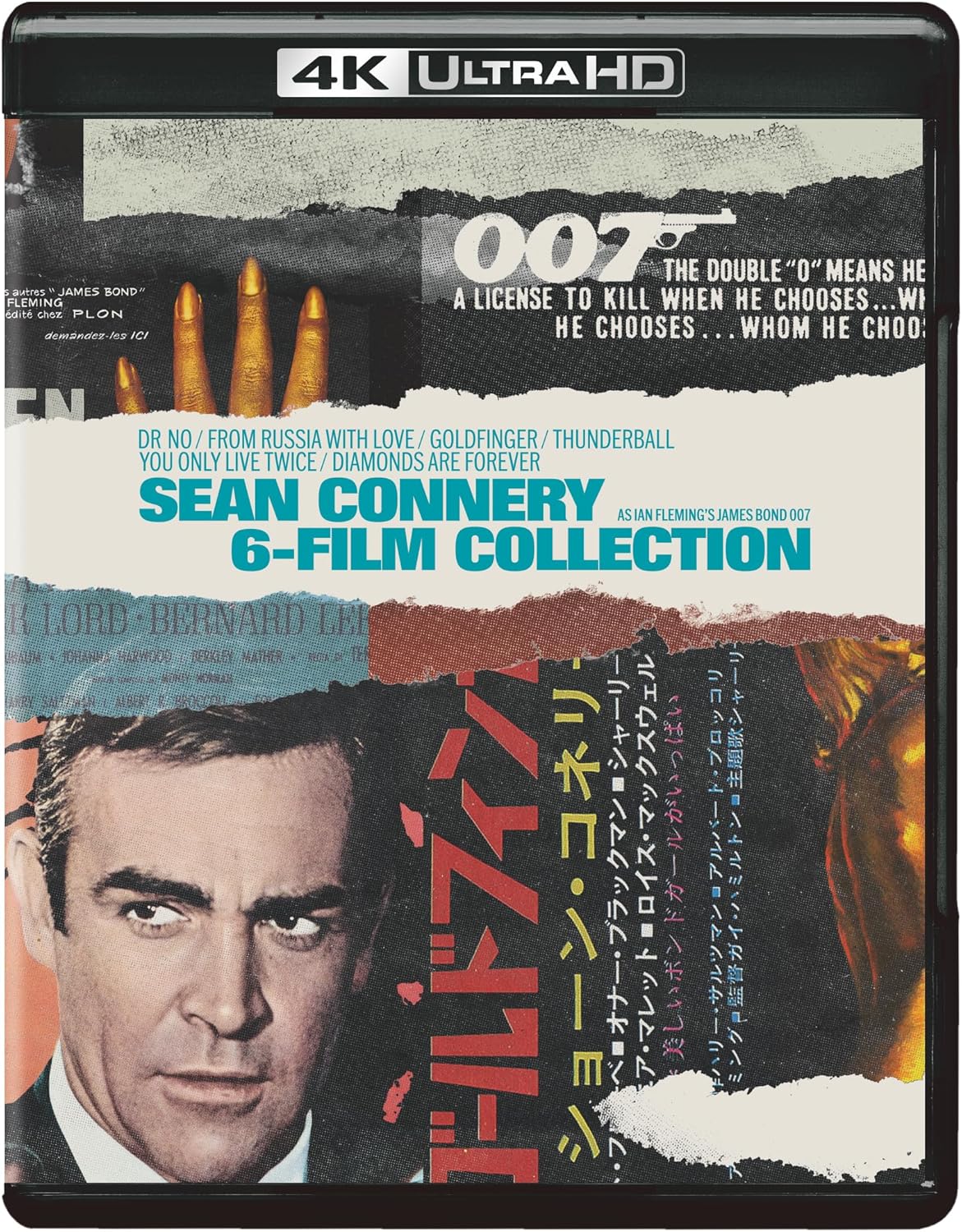
6-FILM JAMES BOND COLLECTION: THE SEAN CONNERY COLLECTION/MGM, Various directors
The phenomenal durability of Ian Fleming’s secret agent 007 continues to amaze. Few fictional heroes concocted in the early 1950s remain in the public consciousness – or indeed in print – but the James Bond franchise, whether on the page, at the cinema, in graphic novels or in computer games, or simply in the popular imagination, seems impervious to the years or to the vagaries of fashion. When the Sunday Times journalist Ian Fleming (1908–64) settled down to pen his first novel, which appeared as Casino Royale in 1953, he came up with a remarkable formula: a secret agent whose ‘licence to kill’ on behalf of Her Majesty’s government meant that he could be unleashed both as a counterespionage operative in Cold War novels such as From Russia with Love (1957) and in the fight against organised crime (in Live and Let Die (1954) and Diamonds are Forever (1956), for example). Bond was also charged with taking on a range of megalomaniac super-criminals, often members of the sinister SPECTRE organisation, including the eponymous villains of Dr No (1958) and Goldfinger (1959), and Thunderball’s Emilio Largo (1961).
The continuing reinvention of Bond on the screen and the page has provided 007 with quite remarkable longevity; he has been portrayed by a variety of very different actors, from Sean Connery to Daniel Craig, and he has been tackled in print by Kingsley Amis, John Gardner, Sebastian Faulks, Anthony Horowitz and others.
For many Bond aficionados, the definitive 007 on screen remains Sean Connery, and even those who have collected the actor’s appearances in earlier Blu-ray editions will be tempted by The Sean Connery Collection in jaw-dropping 4K iterations for the fist time. The set includes Dr. No, From Russia With Love, Goldfinger, Thunderball, You Only Live Twice and Diamonds Are Forever and is available in a deluxe 12-disc SteelBooklibrary case and as a standard 6-disc 4K collection. The 4K Ultra HD Blu-ray discs feature Dolby Vision® imaging that is up to 40 times brighter, andblacks that are 10 times darker. If you thought you’d bought your last upgrade of 007 on disc, I’m afraid you’ll have to think again.
LETHAL WEAPON 4K UHD, Richard Donner, director/Warner Bros
For those aware of the work of the director Richard Donner (the Christopher Reeve Superman and the original The Omen), the fact that Lethal Weapon was so impressive was no surprise – and admirers of the film will have purchased earlier silver disc iterations. However, the Mel Gibson and Danny Glover vehicle has never looked as impressive as it does in this latest 4K version. Donner’s film was a massive hit and launched a franchise that included three sequels and a television series. Completists will relish the fact that this new 4K UHD release includes both the 1987 theatrical version of the film and the 2000 Director’s Cut, which features an additional 7 minutes of footage not seen in cinemas. Looked at in the 21st century, the spiky but affectionate relationship between Mel Gibson’s chaotic detective Martin Riggs and Danny Glover’s mature family man works a treat, and the first film has the advantage of Gary Busey as a memorable villain – not to mention the breathtaking action sequences. At the time of the film’s making, Shane Black was part of a new high-profile group of screenwriters whose lustre has now dimmed, but the humour still lands firmly impressive. Special features include ‘A Legacy of Inspiration: Remembering Richard Donner’ and a piece on the chemistry between the two leads. Fans of the series need not hesitate.