

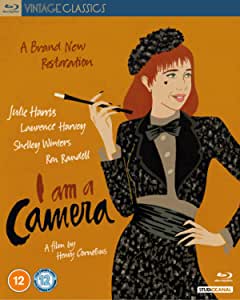
I Am a Camera, Henry Cornelius, director/StudioCanal (May 23)
Barry Forshaw
When important films are unavailable for viewing for many years, the desire among film lovers to catch up with these rarities is strongly accentuated. (Two classic cases of this situation? The Otto Preminger musicals Porgy and Bess and Centennial Summer, both long unavailable because of rights issues.) So it’s particularly pleasing to be able to welcome the dusting off — and new availability of — one of these neglected pieces. Henry Cornelius’s I Am a Camera (1951) is the first film version of Christopher Isherwood’s provocative, free-and-easy character Sally Bowles in 1930s Berlin (his novel Goodbye to Berlin ultimately produced the musical Cabaret). Watching the Cornelius film in this beautifully restored edition is particularly instructive, not least for seeing the ways in which the director and his scenarist John Collier got around the censorship problems of the day (which, of course, no longer applied when Bob Fosse was able to film Cabaret). Isherwood’s much-loved novel captured the amoral bohemian life that flourished in the nightclubs and bars of Berlin just as the Nazis began to obtain their sinister hold on German society. And Sally Bowles – the unconventional London cabaret singer whose lack of responsibility gets her into trouble — is an iconic figure. The film stars the gifted American actress Julie Harris (adapting an English accent) and her exuberant performance won her a Tony in the original stage production of the play. The supporting cast is equally intriguing, with Laurence Harvey as Christopher Isherwood himself (not permitted to be gay in the 1950s, of course, but strongly suggesting – not least through the casting of the actor – sexual ambiguity). Equally plausible is Anton Diffring (before he began his long run of Nazi characters – here he is a potential Jewish victim of the Nazis), and very much playing against type is Shelley Winters as an innocent and naïve girl who runs into Sally and her crowd. (Ironically, of course, Shelley Winters’ own lifestyle was closer to Sally Bowles’ than anyone else in the film – which makes her performance all the more striking.)
In the 1950s, the play was something of a cause célébre; the British Board of Film Censors and the Lord Chamberlain’s office would not permit any film adaptation unless a variety of sanitising changes were made (such as that, for instance, regarding Sally’s pregnancy and abortion); despite this, the film was still considered strong stuff on its release and was granted an adults-only ‘X’ certificate. While there is no denying that Liza Minnelli remains the definitive screen Sally Bowles (despite her making no attempt to capture the character’s Englishness), it’s intriguing to watch Julie Harris’s take, for which a strong case by film critic Anna Smith is made on one of the excellent accompanying extras. The writer Peter Parker’s study of Christopher Isherwood’s career is equally revealing. I Am a Camera is a fascinating curio that is very welcome in its first Blu-ray transfer.