

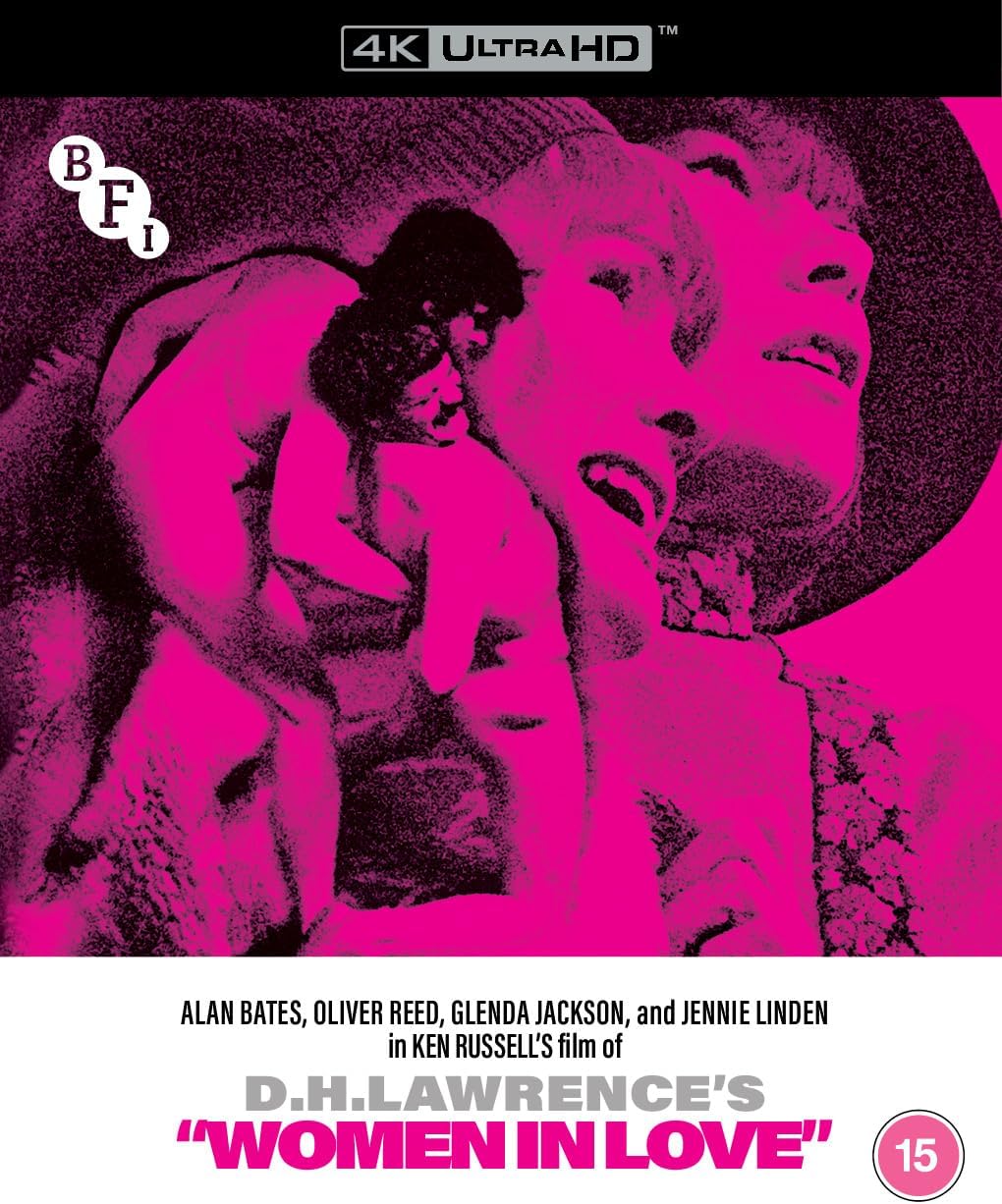
 WOMEN IN LOVE, Ken Russell, director /BFI Blu-ray 4K A very welcome 4K issue. It’s hard to remember in the 21st-century just what a seismic impact Ken Russell’s film of DH Lawrence’s scandalous classic had in 1969. Apart from its quartet of then-hot young players bringing Lawrence’s characters to life (Alan Bates, Oliver Reed, Glenda Jackson and Jennie Linden), Russell’s frank treatment of sex was groundbreaking. Until recently, the film has only been available in a substandard MGM release which – being non-anamorphic – did no justice whatever to the exquisite cinematography. But the BFI are to be applauded for this beautiful restoration of what is probably Ken Russell’s best film for the cinema, looking more eye-popping than it has ever done before. Lawrence’s theme, of course, was always the clash of the intellect and the erotic impulse, and the iconoclastic Russell was just the director to tackle that. But interpretations of the erotic can easily slip into being prosaic descriptions of the mechanics of the act — or move into more rarefied poetic realms which transcend the merely physical. The most conspicuous exemplar of the latter approach was (it goes without saying) DH Lawrence, and the accounts of sexual activity in such novels as The Rainbow and Women in Love (both filmed by Russell at various intervals) so melded and intermingled the physical with the poetic that it was difficult for the reader to figure out precisely what was happening between the lovers. Was that an orgasm we’d just encountered? Or a metaphysical merging of psyches? But Lawrence was at least trying to articulate what was previously terra incognita, and more complex and subtle attitudes to the erotic were a concern for various writers and filmmakers. WH Auden was obliged to pseudonymously publish his one-poem pamphlet ‘The Platonic Blow’ in 1965 with its description of a sexual encounter between two men — two years before such sexual activity was legal. Women in Love also dealt with the taboo. With Alan Bates and Oliver Reed sporting facial hair (and nothing else) in their celebrated nude wrestling scene, cinema was subtly changed in a sequence shot with chiaroscuro candle-lit effects (and to the sensuous sound of Georges Delerue’s sweeping orchestral score). It was this scene, more than those involving the actresses in the film, which was much discussed; Jennie Linden’s dress being pulled up by Bates, and Glenda Jackson’s naked breasts kissed by Oliver Reed had the requisite effect on audiences, but they had seen similar things before — the homoerotic wrestling was something new. Russell had made his name with TV biographies of such classical composers as Delius, Elgar and Debussy, and was well aware that yoking in the other arts would enhance the effect of his feature films; a most serviceable element in this strategy, he knew, was music, although the swelling strings traditionally used in Hollywood love-making scenes had become the hoariest of clichés. Accordingly, Russell encouraged a more unusual score from Georges Delerue. The film is released with a host of special features.
Monthly Archives: July 2025
New from Hammer, Arrow, Eureka, Second Sight, Indicator
 Barry Forshaw
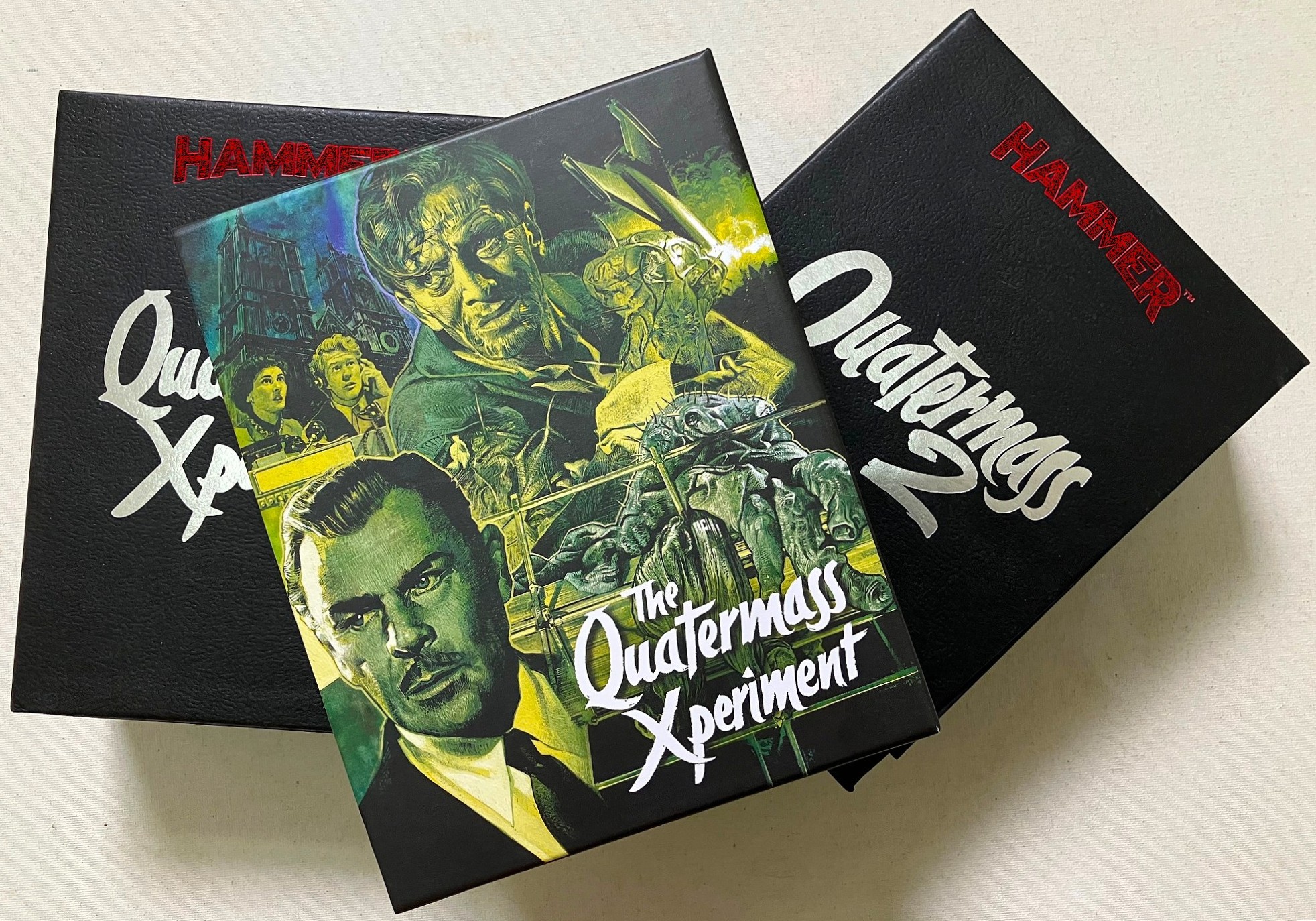
THE QUATERMASS XPERIMENT and QUATERMASS 2, Val Guest, director/Hammer 4K Admirers of British cinema have long relished the remarkable output of Hammer Films studio, famous (or should that be notorious?) for their censor-baiting horror fare before they became a national treasure with The Queen’s Award for Industry. And those same admirers are relishing a series of deluxe silver disc reissues of some of the studio’s key films. The new Hammer personnel will find it hard to beat the presentation of a particularly key film in the studio’s output – the film, in fact, that inaugurated their matchless run of horror product, even though The Quatermass Xperiment is, in fact, a science fiction film with marked horror elements. This latest multidisc issue with a generous selection of extras is absolutely definitive (it even includes a graphic novel by the great British illustrator Brian Lewis– a mentor of mine in my days in illustration). The film (particularly in its 4K iteration) has never looked better. TV was a broadcast medium which would furnish key material for the first horror wave of the mid to late 1950s.and Hammer’s first major horror/science fiction genre initiative was a striking, intelligent adaptation by director Val Guest of Nigel Kneale’s seminal Quatermass series, initially just one of their copious rejiggings of other media, but setting the standard for the company from that point onwards. Interestingly, Hammer’s move into the horror genre was actually occasioned by the success of its adaptation of Kneale’s serial, which, although being firmly in the science-fiction genre, achieved many of its most memorable effects with the use of horror tropes (such as the hideous, sucked-dry husk of a corpse). And it was the latter genre which was to prove the studio’s most enduring legacy in filmic terms. The cadaverous actor Richard Wordsworth made an important contribution to Hammer iconography by appearing as the doomed astronaut in the film, undergoing a grotesque transformation as he was infected by an alien presence brought back from a space mission (his later transformation in the studio’s Curse of the Werewolf is in the nature of the make-up applied to the actor as a spectacularly unprepossessing beggar at a banquet). Kneale’s science-fiction character Quatermass frequently encountered menaces that appeared to have a supernatural agency behind them (but customarily turned out to be alien in origin); television plays such as The Stone Tape (1972) similarly brought about the forced marriage between science and the uncanny (in the latter, occult happenings are investigated by a scientific team with all the apparatus of modern technology — a notion much imitated since). And speaking of imitation (or, more kindly, inspiration), the indebtedness of the Doctor Who series (both before and after its revivification) to the concepts originally created by Nigel Kneale is profound. The much-employed and urbane Val Guest may be regarded as one of the most versatile journeyman directors to have worked steadily in the British film industry – or as a jack of all trades who delivered professional work in a variety of genres. Like many directors, Guest began his career as an actor and even had a period in journalism (an experience that was to stand him in good stead for the pungent, persuasive realisation of the journalistic world in such films as The Day the Earth Caught Fire (1961)). Born in Maida Vale, Guest was brought up in India before coming to London. His first films involved venerable music hall comedians of the day such as Will Hay, but, as a director with an early grasp of commercial imperatives, he began to make his mark with such studios as Hammer, for whom he created the ground-breaking Quatermass Xperiment. This weighty box set will be a very tempting proposition for any lovers of Hammer Films, British science fiction movies – or, for that matter, British films per se — even though the eponymous scientist is played by the brusque American actor Brian Donlevy. As for the second film in the series, Quatermass 2 (with its clandestine alien invasion), this is another exemplary job of adaptation, streamlining Nigel Kneale’s original series into a feature length film – and the fact that the new Hammer Deluxe Edition also contains the original television broadcast gives viewers a chance to compare the two. Most will agree (although Nigel Kneale didn’t!) that Val Guest’s changes are an improvement, and there are those who claim to prefer the second film over the first (the third film, Quatermass and the Pit, is equally impressive). Leaving aside the massive improvement in terms of the sprucing-up of the images here – even the famous dark opening of the second film is enhanced — these weighty new sets form the rejuvenated Hammer are absolute collector’s items with their slew of extras – even if you possess one of the earlier silver disc iterations — are essential purchases.
ZOMBIE FLESH EATERS, Lucio Fulci, director/ Arrow 4K
Most aficionados of the macabre will know Fulci best from this memorable effort, a grisly George Romero-inspired corpse epic in which state-of-the-art special effects of dismemberment and carnage offer a challenge to all but the most stout-hearted. It’s in this film that Fulci’s flat, comic-strip narrative grip flourishes – the plot (Ian McCulloch and Tisa Farrow stumbling through hordes of implacable, worm-infested zombies) is still powerful in the 21st century, particularly in this eye-popping 4k new iteration
HEART OF STONE, Paul Verhoeven, director/Eureka
There is a particular fascination in seeing genre films from other sources than Britain and America, and one area that remains terra incognito for cineastes is East Germany. Eureka, therefore, have done the more adventurous viewers a favour by releasing a revolutionary East German fantasy classic with its fairy tales/fantasy accoutrements worn proudly. It should be pointed out, however, that the director of Heart of Stone, Paul Verhoeven, is not to be confused with the better known Dutch film craftsman responsible for such films as Robocop. This was the first East German production to be shot in colour, and quickly established its reputation as one of the most successful films ever produced in the GDR until the final days of the DEFA studios. As one would expect from Eureka, this is a deluxe job and a very welcome excavation from the vaults.
WHEN EVIL LURKS, Demián Rugna, director/Second Sight Films Second Sight Films – home of the unusual — has issued something of a sleeper in Demián Rugna’s When Evil Lurks – the kind of adroitly made horror film that initially sneaks up on the viewer before delivering something of a gut punch. Utilising the familiar ingredients in an unorthodox fashion, Demián Rugna’s film is worthy of the attention of aficionados of the genre of the macabre.
Finally, three tempting items from Indicator:
THE HIRELING, Alan Bridges, director, is a UK Blu-ray premiere. Based on the classic novel by LP Hartley, this is not just a triumph for the director Alan Bridges but something of a masterclass in acting from Robert Shaw and Sarah Miles in an understated but powerful drama of psychological and sexual repression. The film was awarded the Palme d’Or at the 1973 Cannes Film Festival.
THE TAMING OF THE SHREW, Franco Zeffirelli, director, is the first stab at the Bard from the celebrated Italian director and is delivered with great gusto. The indomitable Richard Burton grabbed with both hands the opportunity to deliver Shakespeare’s text, and Elizabeth Taylor clearly paid close attention to her more experienced partner in this field. The eye-catching cinematography is courtesy of the great Oswald Morris (whose work included The Pumpkin Eater ) and the score is by the doyen of Italian film scoring, Nino Rota.
THE DRESSER, Peter Yates, director, presents another piece of superlative acting of courtesy of Albert Finney, a camp Tom Courtenay and Edward Fox. The writer Ronald Harwood utilised his experience as an assistant to the barnstorming Shakespearean actor manager Donald Woolfit. The director Peter Yates may be better known for such action thrillers as Steve McQueen’s Bullitt and Robbery, but demonstrated here that he is more than capable of finessing a group of actorly performances and forging the perfect record of a pre-existing stage success.
.