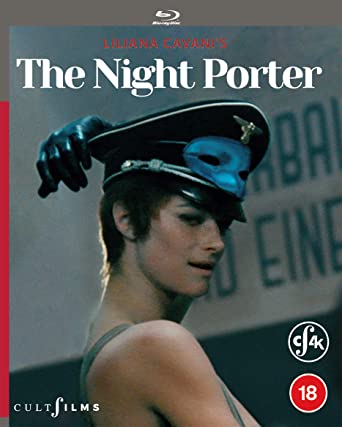
THE NIGHT PORTER, Liliana Cavani, director/Cult Films Blu-ray First time on Blu-ray for Liliana Cavani’s dark erotic drama The Night Porter/Il Portiere di Notte (1974), which became a somewhat scandalous international success, it drew attention to one of the few women directors who have had an ambitious and thought-provoking career in Italian cinema. The director was already considered something of a provocateur, and was not at all fazed by the critical press her film received in the United States. Famously, Pauline Kael suggested that the film was essentially fascist in its attitudes, relishing the sadomasochism that was the engine of the plot. But Cavani would have known perfectly well that the scenario would have its controversial aspects (after the war, a female prisoner of a concentration camp finds herself engaged in bizarre sexual games with the German whom was her torturer, now working in a hotel as a night porter), and was undoubtedly savvy enough to realise that the controversy that the film occasioned would not damage its commercial prospects. Which is not to suggest that this is a catchpenny piece of work; the film is deeply serious in its intent, and it would be something of a specialist audience who would find the sexual games on display arousing. In circumstances reminiscent of the intellectuals (such as EM Forster) who came forward to defend Lawrence’s Lady Chatterley’s Lover during its 1960s prosecution for pornography, The Night Porter quickly found a cadre of supporters, including such heavyweight cultural icons as Luchino Visconti and Michel Foucault. Defences of the film were based on notions of the indomitability of the human spirit (and even the possibility of love) under the most appalling of circumstances. Certainly, the film was immeasurably aided by two impressive performances – the young Charlotte Rampling as the victim (her performance here, however, hardly suggesting the nuanced actress she would become in middle-age) and the ever-reliable Dirk Bogarde, conveying — as he was so adept at doing — multiple contradictory aspects warring in the same character.
Cavani was born in Carpi (part of Modena), and despite her well-heeled family background remained committed to socialist ideals throughout her life, generally, however, avoiding specific political links. After a course at Italy’s National Film School (at which she was conspicuous by being the only female student), Cavani worked for RAI television in a variety of roles, notably on documentaries that often had a political slant. One of these was a history of the Third Reich, elements of which she utilised later in The Night Porter. Her first film was an unorthodox version of the life of Frances of Assisi in 1966 and demonstrated her instant authority. The film echoed Pasolini’s Gospel According to St Matthew by eschewing the sentimental religiosity of Hollywood films and stressing the humanity of the saintly central figure. Her individuality was clearly evident in such films as The Cannibals/I Canniballi in 1969, a rigorous version of Sophocles’ Antigone, with Pierre Clementi and a curiously cast Britt Ekland as Antigone.
It was, however, The Night Porter, which made a mark, directly confronting the links between violence and sexuality in wartime and the forced culpability of the victims as well as the victimisers. The unsparing treatment of female sexuality (such as the bondage games played by Rampling and Bogarde) shocked many, and the fact that the film was made by a woman did not alleviate for the naysayers the outrage felt towards the enterprise – if anything, Cavani’s gender exacerbated the offense.
Later work by the director lacked the shock value of The Night Porter, but Cavani delivered a solid version of Patricia Highsmith’s Ripley’s Game in 2002 (with John Malkovich). In the final analysis, there is no questioning her unusual place in history of Italian film. Cult Films’ 4K restoration sports impressive brand new extras that explore the film’s controversial history and make it ripe for re-assessment. Including new interviews with star Charlotte Rampling and director Liliana Cavani.
MOTHRA, THE H-MAN & BATTLE IN OUTER SPACE, Ishirō Honda, director/Eureka Blu-ray Ishirō Honda’s eccentrically entertaining entry in the ‘Kaiju’ or giant monster field, Mothra, is a very different beast from the film that started it all, also directed by Honda: the durable Godzilla, itself heavily inspired by Ray Harryhausen and Eugene Lourie’s The Beast from 20,000 Fathoms. Apart from anything else, Mothra is female and nothing like as malevolent as her male counterparts. The film itself is delivered with the lightest of touches, and the only version to watch is the original-language version made available here instead of any of the atrociously dubbed versions that you may be familiar with. The film is on home video for the first time in the UK, on Blu-ray as part of The Masters of Cinema Series in a limited edition set of 3,000 copies. Also from Eureka, two more Honda entries: a duo of the quirkiest and most idiosyncratic of Japanese science fiction films, both making their UK Blu-ray debuts. Much sought after by aficionados of the obscure, these visually impressive (but truly eccentric) SF offerings are like nothing you’ve ever seen.
LAKE MICHIGAN MONSTER, Ryland Brickson Cole Tews, director/Arrow Blu-ray A declaration of interest here: I contributed to the booklet for Lake Michigan Monster, and my main point was the enjoyment that can be obtained from films that set out to be deliberately bad, unlike, say, Plan Nine from Outer Space, in which the director Ed Wood most definitely did not have his tongue in his cheek — he was trying to do his cinematic best. Not so the splendidly named Ryland Brickson Cole Tews, who is ruthlessly sending up the horror genre. Tews’ eccentric epic was the winner of the Audience Award for Best International Feature at the 2019 Fantasia Film Festival. Made in black and white with production values that are barely discernible, Lake Michigan Monster’s creator, known to his friends as ‘Ryland Tews’, knows exactly what he’s doing with his parody of the ‘pursuit of a monster’ theme and lovingly recreates every durable cliché of the genre, putting himself at the centre of the adventure as the eccentric bearded captain, Seafield, still dealing with the fact that a grotesque creature consumed his father. Seafield is the ultimate driven hero, and Tews’ own performance as the captain is pitched so far over the top that he would make the average end-of-the-pier seaside panto look like a Chekhov chamber piece. When viewing Tews’ scenery chewing, the vintage films of Tod Slaughter spring to mind as a template. Nobody, of course, believes the frustrated Seafield’s unlikely claims about the death of his father, and he is obliged to put together a crew of oddball specialists in order to hunt down the monster. plot developments could not be odder – including, for instance, the smashing of an egg produced by the creature which the sailor Dick Flynn may in fact have fertilised. Before events reach their outrageous conclusion, the team has to seek a hidden world somewhat in the idiom of Arthur Conan Doyle – though instead of being in a secluded valley, this one is underneath a lake.
The fact that the film got made at all – and that it looks as eye-catching as it does – is a tribute to Tews’ tenacity, something he shared with his predecessor Roger Corman, who similarly made films on the slimmest of
Although it’s hard to see a film like Lake Michigan Monster making a great impression on those who have no interest in the SF and horror genres, for those fully acquainted with all the clichés, there is fun to be had.
COLUMBIA NOIR #1: ESCAPE IN THE FOG (Budd Boetticher, 1945), THE UNDERCOVER MAN (Joseph H Lewis, 1949), DRIVE A CROOKED ROAD (Richard Quine, 1954), 5 AGAINST THE HOUSE (Phil Karlson, 1955), THE GARMENT JUNGLE (Vincent Sherman and Robert Aldrich, 1957), THE LINEUP (Don Siegel, 1958)/Powerhouse Indicator Blu-ray For aficionados of film noir, Indicator’s Columbia Noir Volume 1 will be of keen interest — not just for such classics as Don Siegel’s gritty The Lineup, but for its rarities, including the powerful mobsters-vs-union organiser drama The Garment Jungle, signed by Vincent Sherman but mostly directed by the great Robert Aldrich. In fact, the real interest of the set is as much in the directors involved as in the sharp and lean crime dramas it (mostly) contains. How about this for a tally of cult auteur directors? Budd Boetticher, Joseph H Lewis, Phil Karlson, Robert Aldrich and Don Siegel? All of them are important names in the lineage of the crime movie genre, and even though the films included here are not necessarily their best (although Siegel’s The Lineup is among his finest, once it gets past its pedestrian police procedural opening), all of the directors demonstrate their trademark skill in these highly entertaining efforts. Admittedly, Richard Quine and Vincent Sherman are not in the same class as the filmmakers listed above, but they are still perfectly capable directors.
Budd Boetticher’s Escape in the Fog has a nurse and a war veteran up against Nazi spies in San Francisco, while Joseph H Lewis’ The Undercover Man riffs on the Al Capone case and Richard Quine’s Drive a Crooked Road has Mickey Rooney effective in a straight role as a classic film noir ‘fall guy’. Siegel’s The Lineup has a superb duo of criminals with a homicidal Eli Wallach and an intellectual Robert Keith in something like a gay relationship. All six films are Blu-ray premieres in the UK, with The Undercover Man and Drive a Crooked Road making their world Blu-ray premieres. The set also sports a 120-page book, and is limited to 6,000 numbered units.
CINEMA PARADISO, Giuseppe Tornatore, director/Arrow Academy Blu-ray A welcome release from Arrow Academy of a much-loved film that has gleaned awards galore, including Best Foreign Language Film Oscar, 5 BAFTA Awards and the Grand Prize of the Jury at the Cannes Film Festival. The theatrical version of Cinema Paradiso arrives for the first time on 4K Ultra-HD Blu-ray, as well as Blu-ray and DVD, sporting a slew of extras. This story of a small boy whose father has been killed in the Second World War and finds a surrogate father in the local projectionist is one of the most popular and celebrated Italian films to achieve worldwide recognition in many years. Its massive success is, of course, due to its ‘cute’ child protagonist. For all the trappings of realism for which the film received acclaim, the use of the youthful Salvatore Cascio is not a million miles away from the heart-tugging appeal of child stars through the ages. The reliable Philippe Noiret is value for money, as ever.
ROAD GAMES, Richard Franklin, director/Powerhouse Indicator Blu-ray Film aficionados get a subtle glow of pleasure when they find themselves hooking onto a sleeper before anyone else. Road Games is a film that was not a conspicuous commercial success, but its virtues quickly become apparent to the clued in. It’s no masterpiece, but Richard Franklin’s adroitly made thriller has acquired a following – and, what’s more, it landed him the opportunity to direct the long-delayed sequel to his idol Hitchcock’s Psycho with Anthony Perkins (although, it has to be said, his subsequent career did not attain the heights that we were all expecting). Stacey Keach is a wry, poetry-quoting truck driver who picks up hitchhiker Jamie Lee Curtis while travelling across the Australian outback. She disappears, and Keach’s character finds himself the prime suspect for another vanishing. The whole thing is – unsurprisingly — Hitchcockian (notably the Rear Window echoes and the theme of the innocent man under threat). Some may wish that the film were more eventful, but there is no denying Franklin’s deft touch. The film is presented in an all-new 2020 restoration from a 4K scan of the duplicate negative and comes with extensive bonus features, a double-sided poster, and an 80-page book.
IT CAME FROM OUTER SPACE, Jack Arnold/Fabulous Films Most people will be familiar with Jack Arnold’s science fiction classic so it’s flat rather than its 3D version, but there is no arguing that it looks far better in its 3D iteration (recently made available on Blu-ray), but is nevertheless one of the best entries in the 1950s science-fiction wave, and looks terrific in this new release. Lauded by Spielberg, with music from Henry Mancini and a Golden Globe for Barbara Rush…It Came From Outer Space has Amateur astronomer John Putnam (Richard Carlson) and his fiancée Ellen Fields (Barbara Rush) are stargazing in the desert when a spaceship bursts from the sky and crashes to the ground. Just before a landslide buries the ship, a mysterious creature emerges and disappears into the darkness. Of course, when he tells his story to the sheriff (Charles Drake), John is branded a crackpot; but before long, strange things begin to happen, and the tide of disbelief turns.. Although the screenplay is credited to Harry Essex, most of the script, including dialogue, is exactly as Ray Bradbury wrote it. Bradbury offered two story outlines to the studio, one with malicious aliens, the other with benign aliens. The studio chose the benign aliens which Bradbury was happy about. It was one of the first sci-fi films to feature an intelligent, non-humanoid and non-malevolent alien life form. Steven Spielberg has credited this film, and its plot focused on aliens with no evil intentions, as the main inspiration for Close Encounters of the Third Kind (1977). Barbara Rush won the Golden Globe award in 1954 as most promising female newcomer for her role in the film.