

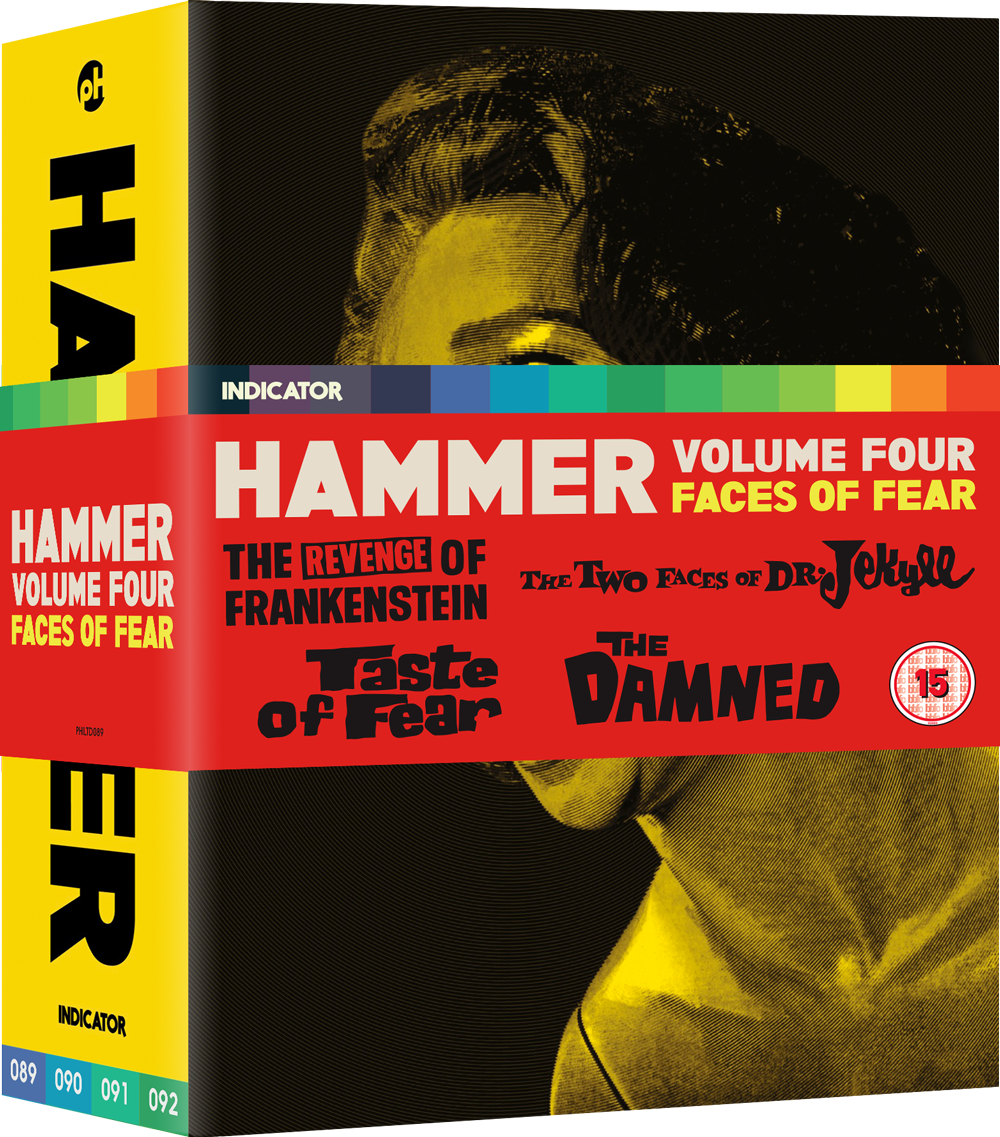
HAMMER VOL. 4: FACES OF FEAR, Various directors/Powerhouse Indicator Blu-ray Bijou Blu-ray company Powerhouse Indicator have performed sterling service with their ongoing Hammer programme, issuing definitive discs of some very collectable films from another bijou company: Britain’s imperishable horror film factory, winner of the Queen’s Award for industry. This fourth volume is another must-have, with definitive spruced-up issues of The Revenge of Frankenstein, The Two Faces of Dr Jekyll (both directed by Terence Fisher), Joseph Losey’s The Damned and the company’s finest Psycho-style thriller, Seth Holt’s Taste of Fear.
The Revenge of Frankenstein in 1958 is an early example of the kind of ingenuity in ringing the changes on pre-existing material which became Hammer’s stock in trade, as the eponymous Baron cheats the guillotine. Substituting for his own execution a priest who has been dispatched to perform the last rites for him, Frankenstein is soon once again primed to resume his experiments. The fact that the audience does not immediately despise him for the ruthless (and homicidal) deception that brought about his freedom is due as much to the casting of Peter Cushing in the part as the writing and direction — which would not have been the case had the part been played by (say) of another Hammer alumni, the far less sympathetic Michael Gough (noted at the time for his sneering expression and supercilious voice — interestingly, when the director Tim Burton, a long-time Hammer aficionado, was (many years later) to cast this actor as Batman’s obliging butler in is highly successful revival of the Bob Kane/Bill Finger superhero, Burton was to uncover surprisingly likable facets of the actor’s personality which had been down ruthlessly tamped down and repressed in the heyday of Gough’s career as a horror actor. But Cushing allows a certain winning charisma to inform his portrayal – one that Terence Fisher knows precisely how to showcase.
And it isn’t long before the Baron is bloodily plying his old trade (under the name of Dr Stein), using the sanatorium for charity patients he now runs as a sort of body bank for his real vocational work. Once again, the real sleight-of-hand here lies not so much in the grisly bag of tricks with which the audience is pleasurably shocked, but in the easily-assumed complicity we adopt towards the Baron’s ruthless practices. Unlike Colin Clive’s inaugural Frankenstein for James Whale (with whom we were hardly involved), the real achievement of Fisher and Cushing is to make us (by proxy) as keen as the Baron is to advance science in his own particular, take-no-prisoners fashion (however queasily we may regards his moral code). In some ways, the complicity invited here is along the lines that Shakespeare creates for his equally cold-blooded Richard the Third, but with the black and sardonic humour incorporated into our observation of the Baron’s actions, rather than being persuaded by a wry address to the audience.
While Jimmy Sangster — in the first entry in the Frankenstein series — appeared to be trying out a variety of approaches to the character (approaches finessed into something more nuanced and interesting via the treatment of the text by Cushing and Fisher), The Revenge of Frankenstein demonstrates a growing confidence and ambitiousness – and even more ambiguity – in the way in which the Baron is realised. In his confrontation with the medical Council in the second film, we see a brisk professional man set against his peers, and a syndrome is established which will be repeated several times in the course of the series. Frankenstein, despite the obvious impatience he feels towards his more intellectually limited colleagues, maintains – initially, at least — a certain professional decorum. Until, that is, the bourgeois limitations and (as he sees it) desperately limited horizons of his colleagues drive him into a cold anger.
The Baron’s apparently worthy social gesture in The Revenge of Frankenstein of working in a hospital where the patients are not drawn from the aristocratic classes is inevitably a sham, given that his real agenda is (as ever) to harvest human body parts for his creation of a human being. But compared to the Medical Council (as we see on a visit they make to the hospital) the Baron is not constrained by any particular social expectations and has a briskly authoritative (but not alienating) manner towards all those he deals with, whatever their class. Here, as written by Sangster and as acted by Cushing, Frankenstein is a modern figure uninterested in the finer points of social behaviour that might be expected of someone from his class. But this is not because of any healthy democratising instinct — it is the product of the Baron’s egomaniacal sense of superiority to the whole human race – he considers himself not only above class, but above all the stultified mores of the time; the mores, in fact, which repeatedly prevent him being allowed to continue with his work. Science is his god, and the utter ruthlessness with which he worships at this particular altar is (unsurprisingly) what makes his charisma and energy so attractive, however murderous his actions. Parallels might be drawn with the cinema’s customary preoccupation with the high-achieving but ultimately doomed gangster whose rise and fall we watched with fascination. The difference from such figures, though, is that Frankenstein may appear to die at the end of several of his films, but we know that (like his supernatural confrère Dracula) he will be back again in another film, doing his bloody work.
As I wrote in British Gothic Cinema, The Two Faces of Dr Jekyll (1960) was an ambitious attempt by the studio to do something different with Robert Louis Stevenson’s durable original. In the 21st century, when such riffs on Stevenson story are commonplace (Hammer itself was to attempt another such filigree with Roy Ward Baker’s Dr Jekyll and Sister Hyde (1971)), a certain historical perspective is needed to appreciate how radical was the notion in The Two Faces (courtesy of the playwright Wolf Mankowitz) to reverse the polarity of the doctor’s transmogrification from a physically unprepossessing, dull and repressed Jekyll to an outrageously handsome dandified Hyde (the Manichean contrast of the good versus evil remains located in Jekyll and his alter ego, as usual), but Paul Massie’s bright-eyed Hyde, glittering with manic intensity and sexual appeal, is quite some distance from, say, Frederick March’s simian, crouched assumption of the role for Rouben Mamoulian in 1931, with flared nostrils and a mouth crammed full of misshapen teeth. Interestingly, even in the early 1960s there was still a resonance to Stevenson’s once-subversive notion that beneath the carapace of rectitude of the upper-middle-class Victorian gentleman was the urgent promptings of a ravening, murderous creature from the id, eager to embrace all the vices that his respectable alter ego would fastidiously reject). The evidence that this was still tricky territory was clear from the fact that Hammer were obliged to once again pre-censor the script and even endure some tampering after the film was finished. As with several other Hammer films, a restoration of certain sequences has repaired some of the damage done to The Two Faces of Dr Jekyll.
The reputation of the fatalistic The Dammed has grown over the years (not lest because it is helmed by one of the great modern filmmakers, the expat American Joseph Losey, but the gem of this set is one of Hammer’s most impressive films.
Hammer’s inconsistent (but often highly accomplished) black-and-white psychological horror subgenre began with the sublimely chilling Taste of Fear (directed by Seth Holt in 1961), its vulnerable young heroine (Susan Strasberg) under extreme psychological strain. The film borrows from two prestigious exemplars (Clouzot’s Les Diaboliques and Hitchcock’s Psycho), and while the use of disturbed mental states as the source of the drama in the Hammer psychological thrillers may not figure in any medical text book, there is no denying that it supplies the requisite elements for the better films trading in horror and suspense. Seth Holt’s Taste of Fear remains the among the best; derivative, certainly, but with the director’s casual mastery of the suspense form effortlessly elevating the film above most similar fare (later entries, such as those directed by Freddie Francis, Nightmare (1964) and Paranoiac (1963), are more fitfully successful but have their virtues).
Barry Forshaw