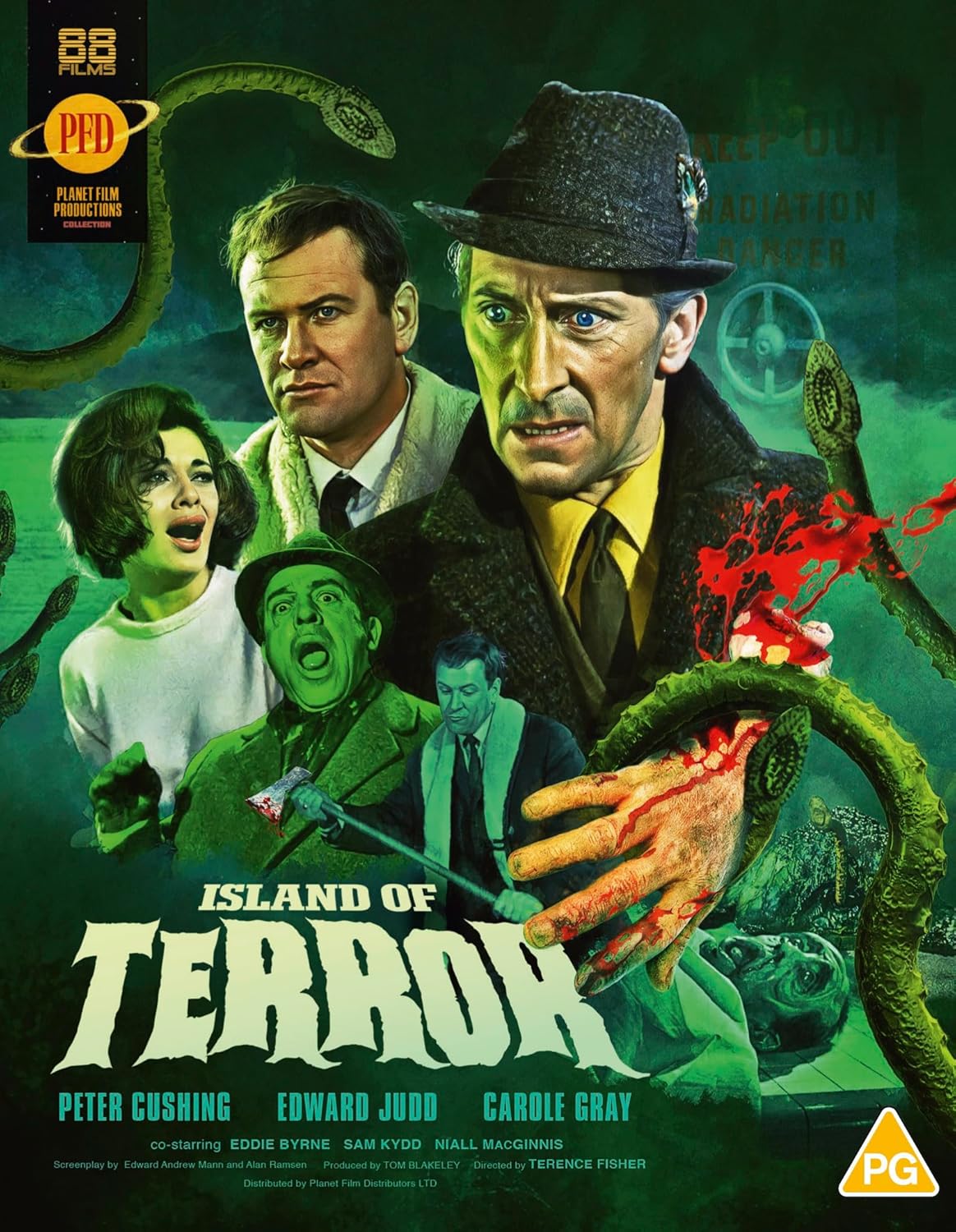
NIGHT OF THE BIG HEAT & ISLAND OF  TERROR, Terence Fisher, director, 88 Films
From 88 Films: two science fiction outings from Hammer’s premier horror director Terence Fisher, for which I provided booklet essays. Apart from the always iconic genre principals – Christopher Lee and Peter Cushing – there was nearly always a cast of highly talented UK character actors and others to bring up the rear in British genre outings. Night of the Big Heat is no exception; the presence of Cushing (as a likeable local doctor) and Lee instantly elevates the material, but there is also the reliable leading man Patrick Allen, along with one of the most characterful of attractive British actresses, Jane Merrow. Although her function in Night is basically that of seductive sexpot (often seen with a minimum of clothing), she is able to make her character believable and persuasive in the sultry situations. The scenario here is similar to Fisher’s other non-Hammer SF work: basically, a small group of beleaguered individuals have to deal with an alien invasion. In Night of the Big Heat, there is an echo of what came to be known as ‘Cosy Catastrophe’, which is not quite as demeaning a description as it might initially appear to be. The science fiction writer John Wyndham had specialised in narratives in which a cloistered community was threatened by an otherworldly force; the most celebrated example is his novel The Midwich Cuckoos (1957), which was filmed very successfully by the director Wolf Rilla as Village of the Damned (1960). The strengths and weaknesses of the human characters dealing with appalling threats, as in Wyndham’s novels, may have been an influence on the original writer of Night, the novelist John Lymington. The very English quotidian settings would have been comforting and familiar to an audience (British or otherwise) and their being under threat is something that is easy to relate to in Night of the Big Heat, which was shot in striking colour photography by cinematographer Reginald H. Wyer.
The companion film, Island of Terror, is set on an isolated locale where gruesome deaths are occurring among locals. What does this have to do with the research establishment on the island working on a cure for cancer? A corpse that has had its bones removed is discovered, along with animals that have met a similar fate. Pathologist Dr Brian Stanley and bone specialist David West are called in and arrive by helicopter. They discover a link to an outbreak in the laboratory – and while venturing into the basement, they come face to face with mutated horrors sporting lethal snake-like tentacles. The premise for Terence Fisher’s Island of Terror (1966) had a variety of potentialities that Fisher – while not inordinately enthused by the science fiction-based commission – explored with his customary expertise. The screenplay for the piece (originally called Night of the Silicates) was not based on a novel; it was an original from the pens of journeymen writers Edward Andrew Mann and Allan Ramsen. Purchased for the bijou Planet film company, the property had excited the attention of the veteran British-born producer Richard Gordon. The latter no doubt spotted that the premise may have owed something to one of his most acclaimed productions, Fiend without a Face (directed by Arthur Crabtree in 1958), which similarly featured hideous – and murderous – mutations laying waste to a community. Gordon had another ace up his sleeve apart from his heavyweight star Peter Cushing: he had also cast the tough British leading man Edward Judd, who had made a considerable impression as a hard-bitten journalist in one of the finest science fiction films made in the UK, The Day the Earth Caught Fire (directed by Val Guest in 1961). Crucial, of course, to the success of the enterprise would be the director – and in that respect, Gordon had secured the dean of British masters of the cinematic macabre, Terence Fisher.
NOTHING BUT THE BEST, Clive Donner, director/STUDIOCANAL
The director Clive Donner had a remarkably varied career, including such successes as his version of Harold Pinter’s The Caretaker which perfectly channelled the sardonic humour of the playwright’s original. There is a different kind of humour to be found in Nothing But the Best, a winning colour outing by the director, but there is still the cutting-edge of his more overtly serious work. Apart from the witty points made about class in Britain, one of the key pleasure the film is its playing – not just the always reliable Alan Bates as the ruthless arriviste anti-hero but a supporting cast that includes the matchless Harry Andrews and Denholm Elliot. The cinematography is courtesy of Nic Roeg.
EXORCIST II & III, VARIOUS DIRECTORS/Arrow
After the all-conquering success of William Friedkin’s The Exorcist, a sequel or two was inevitable (and well before the reboot that the franchise is currently enjoying with new entries). John Boorman’s first sequel — with Richard Burton as the tortured priest investigating the death of Max Von Sydow’s Father Merrin in the first film — was controversial, principally because Boorman delivered something very different from what audiences were expecting. But this splendid-looking new print affords a welcome chance for reappraisal. No such controversy greeted Exorcist III – quite the reverse. The film — directed by the writer of the original novel, William Peter Blatty — quickly established itself as an audience pleaser, not least for the always watchable Georg C. Scott taking over from the first film’s Lee J Cobb as the sardonic Lieutenant Kinderman. And, of course, there is the steadily accumulating tension of the film with one of the great shock sequences of modern cinema. This new version looks better than ever, definition and colour radically improved from earlier iterations.
TOMORROW WE LIVE, George King, director/Indicator/Powerhouse
It’s often a surprise to those unfamiliar with war films of the 40s and 50s how tough such material can be – take for instance the celebrated film of Graham Greene’s Went the Day Well, which spared nothing in its depiction of an occupied British village and the violent retaliation. Similarly confrontational is this powerful effort by Tod Slaughter collaborator George King (Sweeney Todd: The Demon Barber of Fleet Street). King directs Tomorrow We Live, which presents a scenario of wartime resistance in occupied France. The protagonist is played by John Clements, an actor who may not be much remembered today, but was a perfectly professional leading man in such films as The Four Feathers, and he delivers the goods here. Godfrey Tearle‘s most memorable performance was in Alfred Hitchcock’s The 39 Steps, and he is similarly persuasive here, as is the leading lady, Greta Gynt. The film was considered daring in its day, having a notable effect on audiences in 1942, and the picture we are shown of Nazi brutality still has an impact, even with the notion of British actors playing German soldiers with English accents – a better option, in fact, than the bad German accents that had appeared in so many films. Tomorrow We Live is a wartime drama to seek out.
PHAROAH/FARAON, Jerzy Kawalerowicz, director/Second Run
It’s fair to say you’ve never seen anything quite like this hard-to-see film, which is likely to be unfamiliar to most cinéastes. Those with long memories may remember its appearance in the magazine Films and Filming which made the most of the film’s copious semi-nudity – a famous still shows a spectacularly proportioned female character in a translucent gown. But while it might initially appear to be a straightforward biblical epic, this is – as Martin Scorsese pointed out – a fresh approach to the historical picture, with an intelligent and considered portrait of ancient Egypt informed by the political realities of making a film in Poland in the 1960s. The dazzling visuals are afforded the best possible presentation in Second Run’s new Blu-ray.
STING, Kiah Roache-Turner, director/STUDIOCANAL
This is undoubtedly something of a find – an eccentric horror movie delivered with real gusto, sporting an unlikely scenario. An alien spider arrives on earth by meteor before growing in size and munching its way through the cast. Kiah Roache-Turner’s film has exactly the right balance of humour and horror – and also praiseworthy is the attempt to build real characters using the talented cast. Many genre directors don’t seem to take on board the fact that they need to do something radical concerning the endangered characters before they are picked off. That’s an egregious mistake that director Kiah Roache-Turner does not make, and we are edgily involved from the first frame.
THE HITCHER, Robert Harmon, director/Second Sight
Much as filmmakers would like to discern precisely what it is that makes a cult movie, it’s proved difficult over the years to figure out how to catch that particular lightning in a bottle. Sometimes movies acquire a reputation sometime after their initial release – a good example of this syndrome would be Robert Harmon’s The Hitcher, a tautly made road movie that exerts an ever more inexorable grip as it progresses. C. Thomas Howell and Jennifer Jason Leigh are the unlucky couple who find themselves in the sights of psychopathic hitcher Rutger Hauer who seems to take a very personal interest in ruining the life of the luckless Howell character. Apart from Harmon’s deft direction, much of the success of the film is down to the playing. Howell in the less rewarding part of the victim turns in a perfectly serviceable performance, but it’s Jennifer Jason Leigh – quirky as ever – and the charismatic Rutger Hauer who really energise the film, particularly the latter with his air of nigh-supernatural menace. This new 4K edition from Second Sight has the film looking better than it has ever looked before.
THREE MEN IN A BOAT, Ken Annakin, director/STUDIOCANAL
Many viewers will have grown up on television showings of this much-loved British movie, but it’s never looked as impressive – particularly its eye-catching colour palette — as it does on this Studio Canal disc. Based on Jerome K. Jerome’s 1889 novel, this adaptation bagged screenwriters Hubert Gregg and Vernon Harris a BAFTA nomination and was the 12th highest grossing release of 1957. Directed by Ken Annakin, Three Men in a Boat has a winning cast as its hapless sailors: Laurence Harvey, David Tomlinson and the elaborately moustachioed Jimmy Edwards as three Edwardian friends who take a boating holiday on the Thames with multiple disasters ensuing. Though Jerome’s story has had many adaptations, Annakin’s version remains a favourite.
WHEN TITANS RULED THE EARTH various directors/Arrow
Fans of special effects maestro Ray Harryhausen were initially sniffy about this duo of riffs on his work but were won over by the sheer expertise of the creation of a new generation of fabulous monsters – this time forged by CGI rather than the painstaking stop motion methods of Harryhausen. And it’s probably true that for generations not weaned on the late animator, there will be no question of comparison – the new iteration of creatures that the heroic Perseus has to confront more than deliver the goods in terms of spectacle and sense of wonder. When Titans Ruled The Earth is newly released on 4K UHD & Blu-ray from Arrow. In Clash of the Titans, Perseus (Sam Worthington), son of a god but raised as a man, is in conflict with Hades (Ralph Fiennes), bitter god of the underworld. A lethal mission to defeat Hades ensues, with terrifying beasts as opponents. Wrath of the Titans resumes a decade on from Pereus’s battle with the monstrous Kraken, with war raging between the gods and the Titans, and Perseus drawn into the conflict. Spectacle and monstrous creatures abound in both highly diverting films.
THE BELLS GO DOWN, Basil Dearden/STUDIOCANAL
Some films are so well known to fans that the name of the film alone invokes a certain era — and that’s very much the case with this celebrated Basil Dearden film. The Bells Go Down functions both as a drama and as a tribute to the wartime Auxiliary Fire Service, the plucky group who kept the fires of London under control during the blitz and fire bombings of WWII. The organisation here is overseen by professional firemen led by MacFarlane (Finlay Currie) and the younger Ted Robins (James Mason), along with colleagues who include Tommy (Tommy Trinder), and Sam (Mervyn Johns), the latter a petty dockside thief. The lantern-jawed Tommy Trinder won’t be to every modern taste, but this new 4K restoration is festooned with impressive extras.


 Barry Forshaw writes: