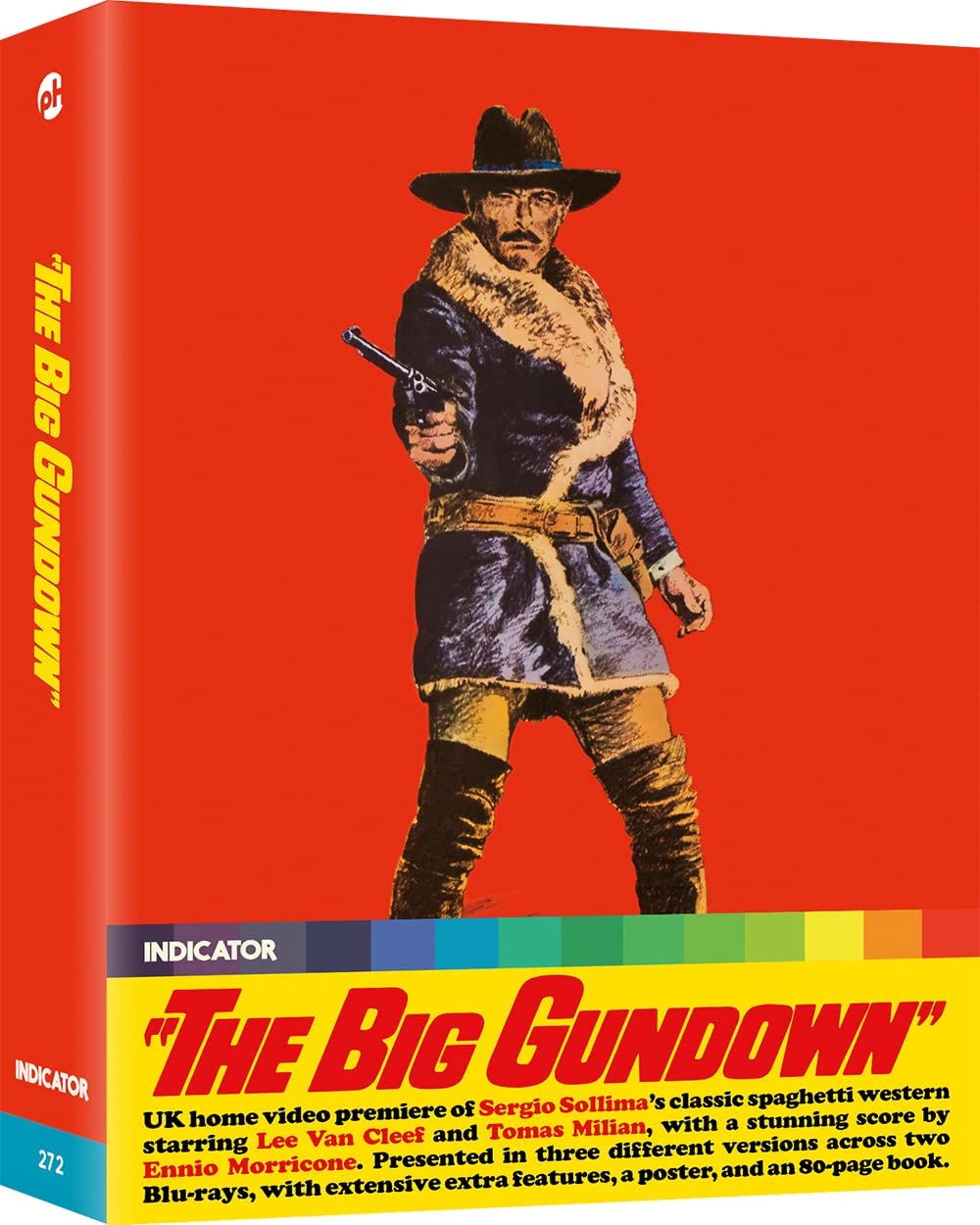
THE BIG GUNDOWN, Sergio Sollima, director/Indicator Let’s start with a film for which Kim Newman and I have provided a commentary. Italian genre master Sergio Sollima’s best-known film is probably The Big Gundown with the iconic Lee Van Cleef, (though attention should also be paid to Faccia a Faccia (Face to Face), an unusual western saga and a striking character piece which contains a metaphor about the rise of fascism). The Big Gundown is a collector’s item with the charismatic Van Cleef and an equally memorable Thomas Milian, and a characteristically jangling score by Ennio Morricone. The film gave Van Cleef his first starring role.
GHOST STORIES FOR CHRISTMAS VOLUME 1, various directors/BFI, 3-disc Limited Edition Certain experiences are ineluctably burned into childhood consciousnesses, and these generational scars are remembered for the rest of the lives of those undergoing such an experience. Shortly after the television terrors of the original British Quatermass series had made its mark on many a viewer, another truly terrifying television experience was talked about for decades after by those who had seen it – and found it a cauterising experience. This was, of course, one of the famous series of BBC films A Ghost Story for Christmas, of which there were 12 – and Jonathan Miller’s 1968 ‘Whistle and I’ll Come to You’ is undoubtedly one of the most famous ventures into the macabre ever shown on British television. With Michael Horden as a fussy academic who unleashes something supernatural and unspeakable, it raised the hair on many a neck in its original showing – and on the various occasions it has been repeated since. It is undoubtedly the centrepiece of the BFI’s exemplary collection of ghost stories to be collected here. Interestingly, a comparison may now be made with the 2010 adaptation of the same story, this time starring John Hurt and directed by Andy de Emmony. Inevitably, highly professional though the latter is, it offers no real challenge to the celebrated original which still works remarkably well in the 21st-century – although Michael Horden’s excessively mannered performance has perhaps worn less well. To impressive viewing figures in the 1970s, the BBC showed this succession of adaptations of the immortal ghost stories of MR James, the Cambridge academic responsible for the definitive eldritch stories written in English. The default director for many of these tales was Lawrence Gordon Clark, who supplies insightful interviews for the new introductions in this remastered series. A handful of these classic tales have appeared before, but it is particularly welcome to see them collected together — and it is easy to see why the series was so influential, and continues to be; in ‘Whistle and I’ll Come to You’, a sceptical academic (Horden) discovers an ancient whistle on a beach in Norfolk and ill-advisedly plays it, releasing a terrifying apparition. What is particularly intriguing about Jonathan Miller’s adaptation is the suggestion that the monstrous thing (which appears chillingly – and simply — as an ambulatory bedsheet) is a product of the professor’s repressed psyche, representing an overlay of then-modern readings of psychosis (sexually-related or otherwise) on the chaste original material. However, of course, while James and the other great ghost story writers who followed him could hardly explore such regions, that is not to say they were not reaching into such dark channels, whether consciously or not. The savvy Miller never twists the material to make any particular points in this area. ‘The Stalls of Barchester’, directed by Lawrence Gordon Clark in 1971, has Clive Swift coming across a box of papers which were the property of the former Archdeacon Haynes (played by Robert Hardy), locked away since the 19th century. Inevitably, of course, they are released. All of the stories are about the unleashing of something unspeakable which wreaks chaos when it is brought into the light – in this case, a clandestine history of bloody malfeasance and supernatural revenge. Once again, a carefully maintained atmosphere is crucial in setting up the eruption into the presents. If the following year’s story, James’ ‘A Warning to the Curious’ (also directed by Lawrence Gordon Clark) is a tad less effective (and hardly as creative in its use of unsettling mise-en-scene), that is as much a comment on the sheer adroitness of the earlier teleplays than on any shortcomings to be found in this adaptation. Extras, as might be expected from the BFI, are copious, and this is a particularly unmissable set.
MAD GOD, Phil Tippett, director/Acorn Media International Over the years, film advertising hyperbole has frequently used phrases to the effect ‘You’ve never seen anything like this before!’ While in almost every case that’s an example of film hype, it is unquestionably true of this remarkable film which combines in surrealist fashion a variety of media to present a story which is utterly original., and of which it has been said: ‘(it) seems to exist in the magical realm of unproduced dream projects’. Directed by two-time Academy Award-winning artist, animator, and filmmaker, the legendary Phil Tippett, this was the most watched Shudder premiere of 2022. Equipped with a gas mask and a crumbling map, the Assassin, an iron-clad humanoid, descends into a rusty, peril-laden underworld of grime, blood, tortured souls, decrepit bunkers and unsettling monstrosities forged from the most primordial horrors of the subconscious mind.
THE CAT AND THE CANARY and THE GHOST BREAKERS, various directors/Eureka It’s good to see two celebrated vintage horror comedies given the deluxe treatment by Eureka, and apart from the films’ principal draw, British-born comedian Bob Hope, it’s a welcome opportunity to look at the best known work of the actress Paulette Goddard. The actress’s appearances in the macabre genre were relatively few, but her career was undoubtedly successful across variety of genres. She made an impression in George Cukor’s The Women (1939), but a move to Paramount led to one of her most fondly remembered films: spoof chiller The Cat and the Canary (1939). Goddard remarked that she was determined to make the most of the film, even though she had been much more keen to test for the part of Scarlett O’Hara in David O Selznick’s Gone with the Wind. (Selznick, in fact, signed her, and for a considerable period she was the primary contender until the perfectionist producer decided against it and sold her contract to Paramount.) The much-filmed property The Cat and the Canary gave Goddard a chance to shine against what would become a career-defining role for Bob Hope, and it acted as a dry run for her second appearance as a menaced heroine in The Ghost Breakers (1940). The silent version of The Cat and the Canary, directed by Paul Leni in 1927, remains a favourite among many discerning fans, but there is no question that the comic remake directed by Elliott Nugent is a great deal more fun. Goddard is the young woman who is to inherit her uncle’s estate if she is prepared to meet certain conditions. Her frequent menacing by a grotesque figure, along with Hope’s nervous comedy, maintains a successful balance between humour and atmosphere, and it’s to Paulette Goddard’s credit that she is not eclipsed by genre icons Gale Sondergaard and George Zucco, both nonpareil practitioners of the sinister. With The Ghost Breakers, Goddard was impressed by the direction of George Marshall and once again proved to be an admirable partner for the wisecracking Hope. The film channelled the same mock-creepy tropes, with a neurotic Hope joining forces with a determined Goddard to spend time in the latter’s newly acquired home in Cuba. Based on a play by Paul Dickey, the film provided more than its share of ghostly apparitions, but the real pleasure (as with the earlier film) was the spiky interaction between the two leads. There were suggestions at the time that the duo were to be put in more, similarly jokey, supernatural material, but wise heads prevailed at the studio, and it was felt that this particular comic vein had been thoroughly mined. Goddard later said she might have declined had there been requests to make similar films. In fact, as with many actors who worked in genre product such as this, she felt obliged to dismiss it as insubstantial fare and praised other entries in her filmography which she considered more respectable. Audiences, and history, have a way of deciding what should last, and her cool attitude to her most famous roles is not echoed by the pleasure they still give viewers, unlike her now forgotten more serious efforts. Aficionados of genre films will undoubtedly always remember her for The Cat and the Canary and The Ghost Breakers, in both of which she shines.
THE BALLAD OF TAM LIN, Roddy McDowall, director/BFI The sole directorial credit of the actor Roddy McDowall is an atmospheric British folk horror from 1971, sorely neglected and resurrected for this welcome BFI issue. Based on a traditional Scottish ballad, and lensed in the Borders, Hollywood’s Ava Gardner is a key element in this unusual piece, which comes with a large selection of extras including an audio commentary by the BFI Flipside co-founders, interviews with cast members Ian McShane and Stephanie Beacham and new interviews with Madeline Smith, and Pentangle’s Jacqui McShee. McShane is the current amour of decadent wealthy widow Mrs Cazaret (Gardner), until things fracture at a Scottish moorland retreat.
THE HUNCHBACK OF NOTRE DAME, Wallace Worsely, director/Eureka This imperishable version of Hugo’s Notre Dame de Paris has long been considered – along with the later Charles Laughton version — one of the definitive takes on the classic novel, much acclaimed for its remarkable performance by star Lon Chaney. The great horror star Chaney’s Quasimodo is particularly memorable, showcasing (as it does) one of the make-ups with which Chaney terrified silent film audiences, as in The Phantom of the Opera. The disc is part of The Masters of Cinema Series, presented from a 4K restoration.
THE WOLFMAN, Joe Johnston, director/ Fabulous Films Boasting an impressive cast (Benicio Del Toro, Emily Blunt, Anthony Hopkins and Hugo Weaving), this extended cut of The Wolfman includes 17 minutes of additional footage not shown in cinemas. The Wolfman was inspired by the classic Universal film, The Wolf Man (1941). Joe Johnston’s remake had a planned cinema release set for 2007 but the release date was deferred till 2010. The controversial CGI effects work well in the werewolf transformations, and the filming at Pinewood Studios, Chatsworth House in Derbyshire and Castle Combe in Wiltshire produced splendid production design results.
DR TERROR’S HOUSE OF HORRORS, Freddie Francis, director/Fabulous Films The notion hopefully propounded by Peter Cushing and Christopher Lee that their films were more innocent, less shocking examples of the horror genre than the field subsequently became known for is perhaps true of one particular film that the duo made together. It was a film that both launched the Amicus portmanteau series of short tales of the macabre, and demonstrated (if such a demonstration were needed) that the mere presence of Cushing and Lee, while providing admirable box-office clout, could elevate material – however familiar – to a more rarefied level. Dr Terror’s House of Horrors the best segment, in which the supercilious art critic played by Christopher Lee is pursued by the severed hand of an artist he has murdered — is a version of Robert Florey’s 1946 film The Beast with Five Fingers). Cushing subtly enjoys himself as the eponymous dispenser of grim fates, seen only shuffling Tarot cards in a railway carriage which looks like no rolling start that ever travelled upon British Railways; with his unlikely bushy eyebrows, cod German accent and rather delicate underplaying, Cushing has the viewer hanging on his every word. The film (capably directed by Freddie Francis), despite its reluctance to deliver the blood-boltered goods to its contemporary audience, did remarkably well and inaugurated the long-running series of Amicus anthology films,
THE CHANGELING, Peter Medak, director/Severin Apart from the sure grasp of suspense techniques demonstrated by director Peter Medak, the principal reason for reacquainting oneself with this much-acclaimed supernatural chiller is the remarkable central performance by George C. Scott, always an actor of considerable authority but particularly value for money here in selling the fantasy elements and grounding them in solid reality.
SILENT RUNNING, Douglas Trumbull, director/Arrow I’m glad to see that the booklet essay I wrote for Arrow’s original release of this ecological science fiction outing has made its way into this splendidly spruced-up edition, a new 4K restoration. I wrote: ‘Science fiction enthusiasts were generally persuaded by Trumbull’s ambition and his excellent choice of leading man, Bruce Dern. There were those who were looking for the more complex and philosophical aspects of the Kubrick movie, 2001, that Trumbull had worked on, but he was less interested in that than in simply telling a tale that would keep audiences transfixed while making points about how the human race is maltreating the planet. The visions of nature, with its vegetation and happily coexisting animals, that appear throughout the film are always Arcadian. In fact, the most effective use of such imagery is in the opening scene before the audience realises that we are on a spacecraft – although, presumably, those who went to see the film in the cinema would have been tipped the wink by the film’s advertising.’ This new edition is, in a word, definitive.
THE TECKMAN MYSTERY & WE JOINED THE NAVY, Wendy Toye, director/StudioCanal Two very different films appear in impressive new 4K restorations, The Teckman Mystery and We Joined the Navy, and both present a welcome opportunity to reassess the career of talented British director, Wendy Toye. We Joined the Navy is an amiable (and very British) comedy, while The Teckman Mystery is a capable crime movie of the kind that was once a default for British filmmakers. Wendy Toye was a British female director of the 1950s and 1960s when few women were doing directorial duty (another practitioner was Muriel Box), and Toye inspired other female film-makers to join the fraternity. The two new restorations arrive with new bonus material, including the short films Stranger Left No Card, On the Twelfth Day… and The King’s Breakfast. Also included: The Extraordinary Career of Wendy Toye, plus interviews with film historian Josephine Botting and critic Pamela Hutchinson.
JEEPERS CREEPERS: THE REUNION, Timo Vuorensola/101 Films We live in an age of horror reboots, so it’s not surprising that the much-admired Jeepers Creepers franchise gets an up-to-date dusting off here. The central premise in the update is a trip to a horror festival arriving in Louisiana for the first time, with diehard horror fans making a pilgrimage. These including a hapless couple played by Imran Adams and Sydney Craven. Needless to say, there is a malign supernatural entity waiting to cut a bloody swathe through the unwitting festivalgoers.
THE FILM VAULT: BLADE RUNNER, GOODFELLAS, SCARFACE, 1917, various directors/Warner Bros., Discovery/Universal The Film Vault is a tempting new collector’s initiative sporting eye-popping 4K renditions of titles drawn from across the Warner Bros, Discovery and Universal catalogues, with four highly-collectable and impressively packaged titles on 4K Ultra HD and Blu-ray: Blade Runner, Goodfellas, Scarface and 1917. With newly-commissioned artwork focussing on a key scene from each of the films, these limited edition 4K releases are highly collectable. Each title will build towards a numbered Film Vault collection, comprising some of the greatest titles in cinema. The four titles are on 4K UHD, and packaged in an acetate slip-cover detailing the title’s numbered entry in the collection, with newly commissioned key art. As for the films themselves, recommendations are superfluous.
DARK AND DEADLY: THE NOIR COLLECTION, Including: THE DARK MIRROR (1946), SECRET BEYOND THE DOOR (1947), FORCE OF EVIL (1948), THE BIG COMBO (1955), Robert Siodmak, Fritz Lang, Abraham Polonsky, Joseph H. Lewis, directors/Arrow Time can be kind to popular genres which were once held in relatively low esteem. When Dashiell Hammett and Raymond Chandler were writing their remarkable private eye novels, they were considered low grade stuff — but just look at the acclaim that these writers now routinely enjoy! The same might be said of the great American Film Noir classics of the 1940s and early 50s which were perceived as audience-pleasing material of no lasting value. And although many have fallen by the wayside, the best of the genre (and there are many films that qualify) are now regarded as among the most striking products of the era. A particularly welcome aspect of the DVD and Blu-ray revolution has been the re-appearance from several companies of some of the best of these films – and there is a particularly cherishable batch currently available from Arrow. Cinéastes looking at the list of directors above will need no persuading to pick these up, particularly in these newly spruced-up editions, as they are largely the gems of the field. In THE DARK MIRROR (1946), directed by Robert Siodmak, Olivia de Havilland plays identical twin sisters (and, as is par for the course in such cases, one good and one evil); SECRET BEYOND THE DOOR (1947) is Fritz Lang’s riff on both the Bluebeard legend and Daphne du Maurier’s Rebecca; Abraham Polonsky’s FORCE OF EVIL (1948) has sleazy lawyer John Garfield, in one of the true classics of the genre, written in blank verse; while Joseph H. Lewis’s taut THE BIG COMBO (1955), sets copper Cornel Wilde against Capo Richard Conte. An unmissable set.
I, THE JURY, Harry Essex, director/ STUDIOCANAL it’s hard at this stage to remember just how considerable was the impact of the tough private eye novels of Mickey Spillane in the 1950s Those who remember the Fred Astaire musical The Band Wagon may think that the private eye segment is a parody of Raymond Chandler, but in fact it’s a version of Spillane’s Mike Hammer. In I, The Jury, Hammer is played by the uncharismatic Biff Elliott, but the film itself is a fascinating example of exploitation films of the day, trying to get away with the maximum that the censors would allow (which of course, was nothing like as extreme as in Spillane’s novel). The film was made in 3D, but is made available here in a flat version. Rated ‘X’ on its initial release, the film was directed by Harry Essex (who wrote the SF classics It Came from Outer Space and Creature from the Black Lagoon), shot by the top cinematographer John Alton, and features legendary Hollywood character actor Elisha Cook Jr
CROUPIER, Mike Hodges, director/Arrow I contributed to the extras for this splendid new edition of Mike Hodges’ Croupier (1998), and in British Crime Film noted that the film was vintage Hodges, with Clive Owen on top form as the morally compromised title character. I wrote: ‘Hodges aficionados, while acknowledging that later films such as Croupier and I’ll Sleep When I’m Dead (2003) did not match the achievement of the director’s signature film, Get Carter, agreed that he still had much to offer the cinema. In the early 21st century, the director began to write quirky crime fiction, but Croupier added to a very respectable filmography.’ The film appears in its deluxe Arrow Video edition looking wonderful, newly restored from the original 35mm camera negative with a wealth of new special features.
RESERVOIR DOGS, Quentin Tarantino, director/Lionsgate Can you remember when Quentin Tarantino’s Reservoir Dogs started to make its remarkable initial impact? Even before the film had been seen in the UK, we were well aware that it was an incendiary combination of extreme violence and witty, caustic dialogue — Tarantino’s career as a cult director was known to us in this country even before we seen this memorable debut. And now we have the film in a limited edition 4K UHD+ Blu-ray SteelBook. it’s the quintessential American gangster movie classic with a group of perfect strangers, assembled to pull off the perfect crime, but ending in bloody chaos. The film has never looked better than in this current iteration.
THE SLEEPING TIGER, Joseph Losey, director/StudioCanal Dirk Bogarde stars in The Sleeping Tiger (1954), a salutary example of the director Joseph Losey’s skill at investing the tired clichés of the crime film with something new and innovative – and doing this with a dynamism that make the clichés of the genre come shaking out like loose nails. Dirk Bogarde (whose teenage thug in The Blue Lamp had signally lacked any sense of verisimilitude) is much more effective in the hands of the director with whom he was to do some of his best work (when both men have moved firmly beyond the genre requirements of a project such as this). Here, Bogarde is a young thug who is being treated as something of experiment by the supercilious psychologist played by a frosty Alexander Knox, locked in an unsatisfactory marriage. Canny viewers will have realised that the psychologist’s initially unsympathetic wife, for all her caustic right-wing views and impatience with notions of rehabilitation, is destined to end up as mere fodder for the attractive but dangerous young man. Alexis Smith is able to invest a clichéd character with a fair degree of smouldering, suppressed eroticism beneath the carefully preserved image of rectitude – and Losey skilfully conveys the fact that what slender passions the psychologist played by Knox nurtures are for his profession and the youthful charge he hopes to save rather than his neglected wife. Keeping firmly on the right side of melodrama, Losey is particularly adroit at playing with audience expectations regarding the inevitable destruction which will result from this volatile clash of personalities. It might be argued that the sexually-frustrated wife played by Alexis Smith is the victim of a strong will to destruction, a textbook case of a certain kind of fatalistic determinism, not a million miles away from the novels of Thomas Hardy. In this area, the American Losey mostly proves himself – not for the last time – as a very English artist.
BARRY FORSHAW


 Mediumrare Entertainment has the crime drama EMILY THE CRIMINAL for 2023. An extraordinarily assured debut from writer/director John Patton Ford, EMILY THE CRIMINAL sees Aubrey Plaza (Parks and Recreation) as a young woman driven to credit card fraud in Los Angeles. Plaza is absolutely hypnotising in the title role, Plaza, better known for her comedy roles, here completely immerses herself in the role of Emily – unable to find a decent job because of a past conviction, and driven to desperate measures.