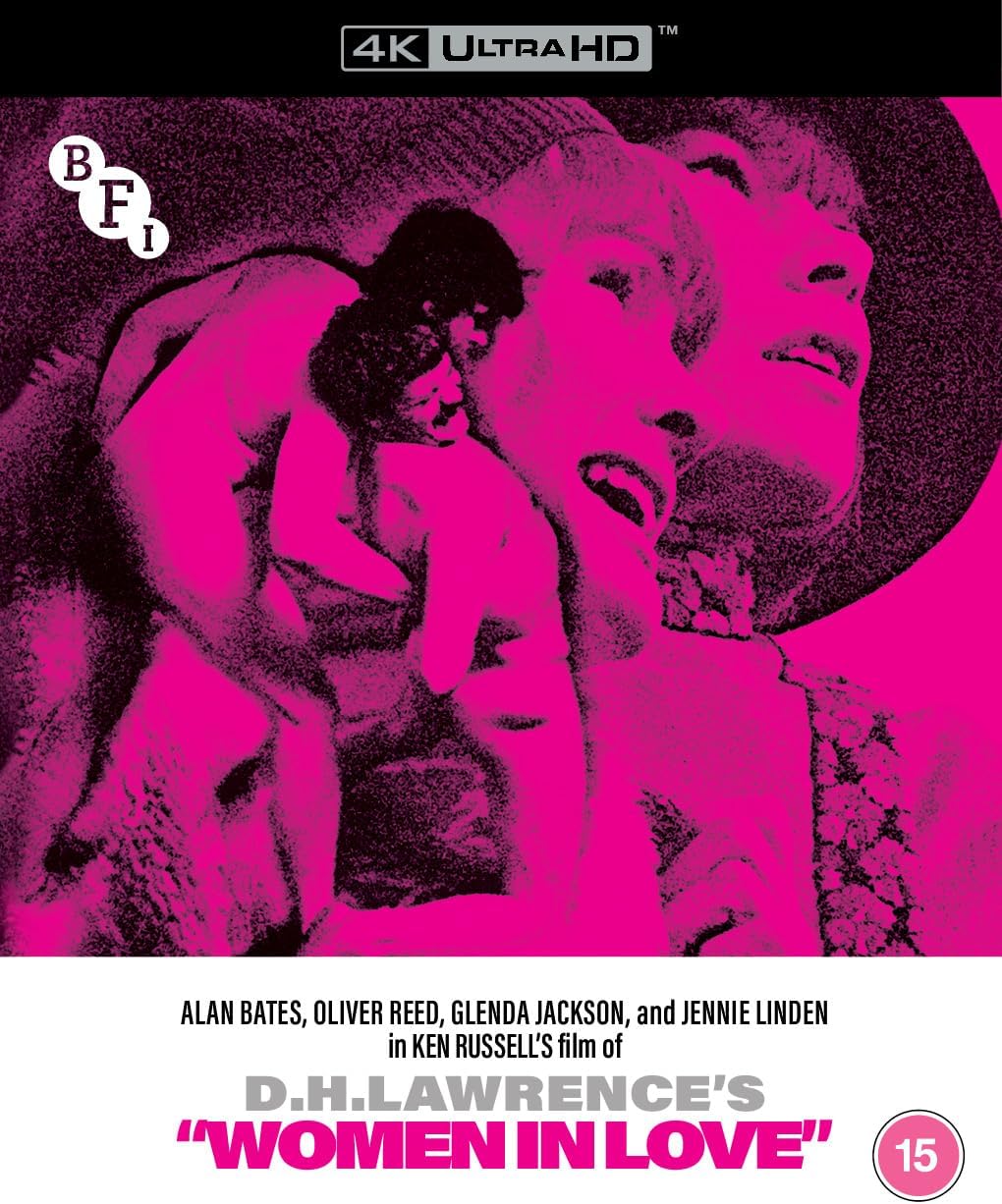
 WOMEN IN LOVE, Ken Russell, director /BFI Blu-ray 4K A very welcome 4K issue. It’s hard to remember in the 21st-century just what a seismic impact Ken Russell’s film of DH Lawrence’s scandalous classic had in 1969. Apart from its quartet of then-hot young players bringing Lawrence’s characters to life (Alan Bates, Oliver Reed, Glenda Jackson and Jennie Linden), Russell’s frank treatment of sex was groundbreaking. Until recently, the film has only been available in a substandard MGM release which – being non-anamorphic – did no justice whatever to the exquisite cinematography. But the BFI are to be applauded for this beautiful restoration of what is probably Ken Russell’s best film for the cinema, looking more eye-popping than it has ever done before. Lawrence’s theme, of course, was always the clash of the intellect and the erotic impulse, and the iconoclastic Russell was just the director to tackle that. But interpretations of the erotic can easily slip into being prosaic descriptions of the mechanics of the act — or move into more rarefied poetic realms which transcend the merely physical. The most conspicuous exemplar of the latter approach was (it goes without saying) DH Lawrence, and the accounts of sexual activity in such novels as The Rainbow and Women in Love (both filmed by Russell at various intervals) so melded and intermingled the physical with the poetic that it was difficult for the reader to figure out precisely what was happening between the lovers. Was that an orgasm we’d just encountered? Or a metaphysical merging of psyches? But Lawrence was at least trying to articulate what was previously terra incognita, and more complex and subtle attitudes to the erotic were a concern for various writers and filmmakers. WH Auden was obliged to pseudonymously publish his one-poem pamphlet ‘The Platonic Blow’ in 1965 with its description of a sexual encounter between two men — two years before such sexual activity was legal. Women in Love also dealt with the taboo. With Alan Bates and Oliver Reed sporting facial hair (and nothing else) in their celebrated nude wrestling scene, cinema was subtly changed in a sequence shot with chiaroscuro candle-lit effects (and to the sensuous sound of Georges Delerue’s sweeping orchestral score). It was this scene, more than those involving the actresses in the film, which was much discussed; Jennie Linden’s dress being pulled up by Bates, and Glenda Jackson’s naked breasts kissed by Oliver Reed had the requisite effect on audiences, but they had seen similar things before — the homoerotic wrestling was something new. Russell had made his name with TV biographies of such classical composers as Delius, Elgar and Debussy, and was well aware that yoking in the other arts would enhance the effect of his feature films; a most serviceable element in this strategy, he knew, was music, although the swelling strings traditionally used in Hollywood love-making scenes had become the hoariest of clichés. Accordingly, Russell encouraged a more unusual score from Georges Delerue. The film is released with a host of special features.


 THE OUTFIT, John Flynn, director/Arrow