

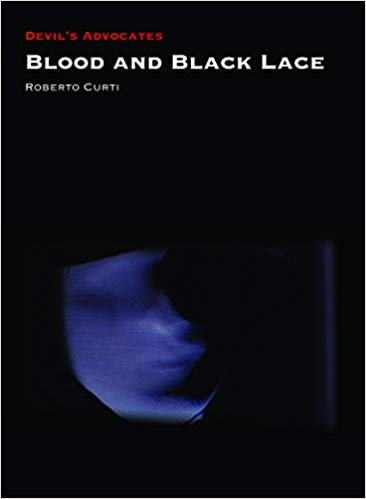
Barry Forshaw writes: The Devil’s Advocates imprint from Auteur Publications has long proved its worth by supplementing the BFI studies of individual films, with carefully researched volumes that invariably do justice to the cult films discussed (I exempt from this praise – for obvious reasons – my own contribution to the series: a study of the Jonathan Demme film of Thomas Harris’s Silence of the Lambs). Two recent additions to the series, however, are something special: Samm Deighan’s rigorous study of the classic Fritz Lang crime thriller from the director’s German period, M, which lays out in fascinating detail the planning, filming and reception of Lang’s unsparing study of a child murderer (with its star-making turn by a young Peter Lorre). It’s a book that will send readers back to the original film.
But for this reviewer, admirable though the Deighan is, it is Roberto Curti’s study of Mario Bava’s Blood and Black Lace that is particularly valuable. Curti has long been one of the principal experts on the Italian giallo (the gruesome murder thrillers that are extremely influential to this day), and as in Curti’s earlier work, he once again has the total measure of Bava’s influential thriller.
Bava’s solo career was launched with the hypnotic black and white cult classic Black Sunday (La Maschera del Demonio, 1960), a film that easily transcended its indifferent acting and wretched dubbing to come across, even today, as one of the most poetic and lyrical of vampire movies. Throughout his career, Bava’s fluid camera and brilliant use of atmospheric sets created a haunting sense of unease in the viewer, and his years of experience as a lighting cameraman result in what has justly been called the finest monochrome photography in the horror genre.
His signature film (after Black Sunday) remains Sei (or 6, as Curti tells us) Donne per l’Assassino (Blood and Black Lace, 1964). Bava’s tale of a masked killer prowling a fashion house remains the blueprint for the giallo. In the UK, the film was sometimes hooted off the screen for the achingly crass dubbing. But new Italian language prints have made it possible for viewers to feast on the visual delights afforded by chiffon, marble, and the director’s cat-like camera. The crippling UK censorship cuts that truncated every murder are restored and the elegantly rendered tension is now unspoilt.
Curti’s concise study, though a mere 118 pages, crams in every possible morsel of information about Blood and Black Lace. It’s an essential adjunct to any viewing of the film.
Blood and Black Lace by Roberto Curti & M by Samm Deighan are published by Auteur