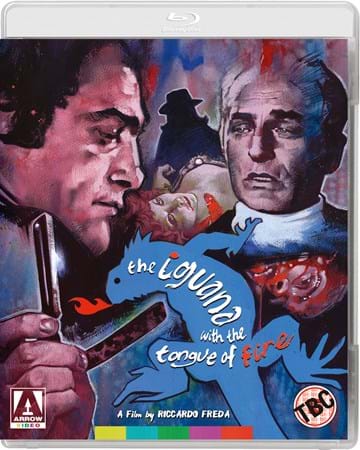
Barry Forshaw writes: THE IGUANA WITH THE TONGUE OF FIRE (L’Iguana dalla Lingua di Fuoco), Riccardo Freda, director/ Arrow Blu-ray The fact that one of the most distinguished names in Italian genre cinema, the great Riccardo Freda, chose to direct this under the pseudonym of Willy Pareto speaks volumes about his own feelings. It is surprising that he should feel none too proud of this, given that other films on his CV (one would have thought) might have inspired a similar wish to disown them. As I noted in my Italian Cinema: Arthouse to Exploitation, the real reason why Freda may not be proud of this one is not so much its level of violence (no more or less than the average giallo) but its level of achievement: the director’s visual flourishes are severely restrained compared with his customary standards. The credits sequence establishes that this is Dublin (gialli are never afraid to transplant their extremely Italianate actors into highly unlikely foreign cities). Soon after the opening sequence, an attractive young woman opens a door. An unseen assailant throws vitriol in her face, scarring her hideously, then raggedly opens her throat with a cutthroat razor. This extremely grisly beginning suggests that what follows will be a catalogue of horrors, but in fact such moments become rarer as the film progresses, although Freda pulls out all the stops for the eye-opening finale. Diplomatic immunity is stifling the investigation, so Inspector John Norton is brought in, a Dirty Harry-type who is prepared to bend the rules. The casting of this Celtic copper is particularly unlikely, as Italian genre regular Luigi Pistilli plays the part; given his Italianate features and familiarity from other films in the genre, the accent he is saddled in the English dub with seems even more unlikely than ever (but the Italian language dub is the one to watch). As usual, a variety of red herrings are paraded before us, but it is clear that Freda was less than fully engaged with this material, until, that is, a mother and daughter (the latter inn a state of Lolita-like undress) are menaced by a sexually ambiguous psychopath. As Norton bursts in and a bloody fight ensues, the entire scene reaches a level of delirium (and brutality – note the treatment of Norton’s mother) that is unusual even in this genre. Nevertheless, The Iguana is very much a footnote in Freda’s otherwise distinguished career. One of several ‘animal-in-the-title’ cash-ins released in the wake of Dario Argento’s box-office smash The Bird with the Crystal Plumage, The Iguana with the Tongue of Fire is a lively and excessive giallo that boasts a rogues gallery of perverse characters; violent, fetishized murders, and one of the genre’s most nonsensical, red-herring laden plots (which sees almost every incidental character hinted at potentially being the killer). The Arrow release features a new 2K restoration, a new commentary by horror experts David Flint and Adrian J. Smith, and newly commissioned artwork by Graham Humphreys.
THE NIGHT OF THE GENERALS, Anatole Litvak, director/Eureka Entertainment Blu-Ray While little read these days, the novel The Night of the Generals by Hans Hellmut Kirst is highly regarded. In WWII Germany, a series of murders seems to have been committed by a high-ranking army officer, and a brace of officers are the main suspects. To some degree, Anatole Litvak’s film strips out the layers of psychological depth of the novel and makes it perfectly clear via larger-than-life performance which of the various actors playing the officers is the one eviscerating prostitutes. With a background of war and non-cooperation, the investigating officer played by Omar Sharif struggles to nail the killer — but no more so than Sharif himself when set against such veteran scene-stealers as Donald Pleasance and Peter O’Toole. The shift from the dark psychological verisimilitude of the novel to the high camp theatrics here makes for an entertaining and unusual movie, looking particularly good in this Blu-ray transfer. Eureka Classics present the film in its UK debut on Blu-ray, utilising a 4K restoration.
THE CARETAKER, Clive Donner, director/BFI Blu-ray It’s hard now to remember a time when the late Harold Pinter was not considered a national treasure. For those with any doubts for about the fact that he was the greatest modern British playwright, this brilliantly successful film of one of his best plays will be a salutary experience. With its impeccable performances (notably from Donald Pleasance as the wheedling tramp Davies and Robert Shaw as the partially lobotomised Aston who invites him home one night) and Clive Donner’s sympathetic, alert direction, this was one of the most successful transitions to film of a difficult stage play. And with Alan Bates in strong support, it’s possible to savour that rich and wonderful dialogue anew, particularly in this splendid DVD transfer from BFI. Whilst renovating his dilapidated home, Aston (Robert Shaw) invites an irritable and devious vagrant (Donald Pleasence) to stay. But, when his ill-tempered brother Mick (Alan Bates) returns, an ominous yet darkly comic power struggle between the trio commences. Newly restored from the original camera negative by the BFI, and presented here in High Definition and Standard Definition with an audio commentary by actor Alan Bates, director Clive Donner and producer Michael Birkett (2002)
TERRA FORMARS, Takashi Miike, director/Arrow Blu-ray How does one approach this virtually unclassifiable film? The title and advertising imagery suggest the much-mocked Transformers series, but this eccentric project couldn’t be more different. The director Takashi Miike is, of course, best known for his hyper-violent and visually inventive films which — while often bizarrely funny — have at least a glancing acquaintance with reality. That’s not the case here: this is a strange mélange of science fiction (notably Starship Troopers with grotesque alien bugs slaughtering — and being slaughtered by — the team of crack astronauts, and also superhero movies – the astronauts here have a way of physically transforming into even stranger hybrid creatures than the monstrous aliens they are attacking. All this is delivered with Miike’s tongue firmly in his cheek (the ludicrous aliens are genuinely the ‘BEM’s of early SF: literally bug-eyed monsters), but as a piece of self-consciously junk cinema, it’s hard to resist. This Japanese SF extravaganza is adapted from the popular Manga series of the same name. and sports a slew of extra features.
BEYOND THE SKY, Fulvio Sestito, director/RLJ Entertainment There was a time when science fiction films were relatively few and far between. After the 1950s boom in the genre, SF box office success was largely ensured by an infusion of horror. How things have changed, now that the genre rules the roost in the cinema – and this is an intriguing addition to the field. With a suggestion of found-footage documentary, Beyond The Sky has Ryan Carnes as a short-fused sceptic convinced that recollections of alien abductions are false memories made to mask other traumas. Jordan Hinson plays a young woman who is to change his sceptical views. Don Davis of The Matrix supplies as impressive score while cinematographer Chris Saul makes a mark with his striking visuals that deserve to cement him as a cinematographer to watch. Filmed in New Mexico, location of the Roswell incident.
BLACK MOON RISING, Harley Cokliss, director/Arrow Blu-ray With his first few films (notably Halloween and Assault on Precinct 13) the director John Carpenter could simply do no wrong — before, that is, his streak of luck ran out and his cinematic output became more fitfully successful. But Carpenter was still riding high when he wrote the screenplay (rather than directed) this kinetic action thriller, much enhanced by the presence of the always-reliable Tommy Lee Jones as an ace criminal whose aim is to capture the prototype vehicle of the title from Linda Hamilton (of The Terminator fame). And while the performances here are suitably larger-than-life, it’s the action sequences – notably the turbocharged car chases — which helped the film acquired cult status. Those who only saw Black Moon Rising on fuzzy VHS are in for a treat with this new Blu-ray restoration. Extras here include a new interview with then much-employed composer Lalo Schifrin, behind the scenes footage and alternative scenes.
ALIEN, Ridley Scott, director/Fox Blu-ray Ridley Scott’s massively influential SF/horror classic, celebrates 40 years with an all-new 4K Ultra HD™ master. This is the film that birthed the wildly successful franchise. The crew of the deep space tug Nostromo awaken from stasis during a voyage home to Earth when their ship’s computer detects what is believed to be an alien distress signal coming from the desolate nearby moon, LV-426. While investigating, one of the crew, Kane (John Hurt), is attacked by an alien creature that latches to his face and he is rushed back to the Nostromo to receive medical treatment. Ripley (Sigourney Weaver), the ship’s warrant officer, advises against Kane’s return due to quarantine regulations – but her orders are ignored by Ash (Ian Holm), bringing the Nostromo under threat from a mysterious, extraterrestrial apex predator with violent and lethal survival instincts. With its remarkable Jerry Goldsmith score, the film was restored in 4K in 2018, supervised by Ridley Scott and Pam Dery.
THE PRISONER, Peter Glenville, director/Arrow Academy Blu-ray After a long string of comic roles, Alec Guinness moved his career in a very different direction with his powerful portrayal of a tormented priest accused of treason in a totalitarian Communist country in this dark and severe drama. His biographers have considered that Guinness’s research for the part was one of the reasons the actor himself turned to Catholicism – which in the context of the film itself may seem somewhat counterintuitive as the priest at the centre of the narrative here harbours considerable doubt about his faith. The actor’s performance may be theatrical (he originated the part on stage) but is still mesmeric, and Guinness is perfectly matched by the ever-excellent Jack Hawkins as the interrogator using psychological warfare against the priest. It’s interesting that the film shares a title with the cult Patrick McGoohan TV series which replicates several elements here, notably the clash of wills between a prisoner and a ‘Number Two’ figure. As an analysis of faith, doubt and the power of the state, this is strong and authoritative stuff. The Blu-ray includes a video appreciation of the film and a booklet with new writing by Mark Cunliffe.
MR TOPAZE, Peter Sellers, director/ BFI Flipside Blu-ray Now that viewers are finally able see Peter Sellers’ sole (and commercially unsuccessful) attempt at directing, it’s clear that — unlike his fellow actor Charles Laughton’s one attempt at directing, Night of the Hunter – Sellers did not produce a neglected masterpiece. Nevertheless it’s a fascinating exercise, long unseen, with the splendid cast largely given their head by Sellers. Kudos must go to the BFI for making this long unseen film available. Mr Topaze teamed Sellers with his Ladykillers cohort and future Pink Panther comic foil Herbert Lom, in a stellar cast that also features Nadia Gray, Leo McKern, Billie Whitelaw and John Le Mesurier. Playing the eponymous Mr Topaze, a poor, provincial French schoolteacher slowly corrupted by big business, Sellers is at the peak of his powers. This melancholy character comedy has rarely been seen since its release and available here for the first time on Blu-ray and DVD; Extras include The Running Jumping & Standing Still Film (1960) directed by Richard Lester, a variety of interviews and more.
ONE TWO THREE, Billy Wilder, director/Eureka Entertainment While not the equal of such classic Billy Wilder comedies as Some like it Hot and The Apartment, the sheer pace and energy of this neglected Cold War comedy makes for an exhilarating (if exhausting) experience, largely powered by James Cagney’s high-voltage performance; even as a heavy-waisted middle-aged man, the energy Cagney conveyed as a young man in the 1930s gangster films that made his name is still clearly in evidence. And interestingly the extremely brisk pace of the film — much remarked upon in its time — has finally come into its own, making the film look very contemporary. Cagney is C.R. “Mac” MacNamara, a soft drinks company executive in West Berlin who has been instructed to keep an eye on his boss’ 17-year-old socialite daughter Scarlett (Pamela Tiffin) while she visits Germany – problems (and higher blood pressure) ensue when she falls for hot-headed young communist Horst Buchholz.
NO ORCHIDS FOR MISS BLANDISH, St John Legh Clowes, director/Powerhouse Indicator Blu-ray In the 1940s, one of the most influential of filmic challenges to the British status quo occurred, resulting in a radical rethink on censorship and a much more frequent use of the censor’s scissors. In British Crime Film, I talked about the astonishing furore that greeted the 1948 British film of James Hadley Chase’s No Orchids for Miss Blandish now seems absurd. The direct replication of the screams of outrage that greeted the source novel were, perhaps, to be expected – given the fact that the director St John Legh Clowes (whose sole film credit this is) clearly set himself the task of producing the strongest and gamiest material (within the censorship of limitations of the day) that he could get away with, to match his source material. In fact, the very fact that Legh Clowes did (initially, at least) get away with it sent out a false signal: a new dark age of censorship was to follow the film, and the consensus between critics and moral guardians quickly coalesced along the lines of ‘how was this depraved drama allowed to be passed uncut’? In fact, the stricter censorship of sexual scenes and violence that followed the lenient treatment of this film was to be echoed in the 1970s after the then-head of the British Board of Film Censors Stephen Murphy took the decision to allow adult audiences to make up their own minds about such contentious films as Stanley Kubrick’s A Clockwork Orange and Sam Peckinpah’s Straw Dogs – liberal decisions whose consequences were to create a similar drawing-up the battle lines between those who argued for the freedom of filmmakers to follow their vision without fear of upsetting the squeamish or the prudish. As with the 1948 brouhaha over the Legh Clowes film, there were those in positions of authority who felt that mass-market films (along with other forms of popular entertainment) offered a serious challenge to established morality if they moved into certain taboo territory.
James Hadley Chase’s original plot details how a wealthy young heiress is kidnapped by a depraved gang led by a monstrous mother figure (the latter was patterned after several influences: the real-life Ma Barker gang (with its rebellious alpha male son who wrests control of the gang from his suddenly weaker Mother – a motif maintained both here and in several films based on the real-life Ma Barker gang, such as Roger Corman’s eponymous piece with Shelley Winters), and also the classic American novelist William Faulkner whose shocking 1931 novel Sanctuary similarly featured the brutal rape of a kidnapped young woman (interestingly, the American actor Jack La Rue, who was to be hired for the British film of No Orchids (after such actors as George Raft and Franchot Tone passed on the project) had already played in the similar part of the kidnapper in a 1933 film of Faulkner’s novel, retitled The Story of Temple Drake. Ironically given the uproar that the British film created, it still represented a considerable softening and neutering of the original novel, in which the brutal psychopathic rapist Slim Grissom is presented as a loathsome figure as opposed to the more sympathetic Bogart-like characteristics he is granted by the British writer-director and American actor here. Similarly, the aspect of the novel that so outraged George Orwell in his famous essay Raffles and Miss Blandish written four years before this film (such as Slim’s orgasms when knifing a victim to death) were nowhere to be seen, but such elements were also removed by the author himself in the heavily censored version of the novel he himself prepared, perhaps smarting from Orwell’s attack as much as the more general moral outrage the book generated. Having said this, it should be noted that the violence and sexuality in the film is unquestionably more unbuttoned and graphic than in most British product of the day, and is much closer to the pre-Hayes code mayhem of early James Cagney crime movies. But that very violence – not least because of its maladroit handling – is more likely to promote laughter than revulsion in modern audiences for several reasons: the barman bloodily hit across the face by a bottle is played by the comic character actor Sidney James, sporting one of the film’s many unconvincing American accents – and even when the actor reappears with his face bandaged (and having suffered the apparent loss of an eye), there is no real sense of violent injury. Similarly, the Foley track of the film – before sound designs were referred to as such – presents an unconvincing sound picture, with the many gunshots sounding like cap pistols.
In terms of sexuality, however, the film remains more intriguing. The producers may have been unable to secure the services of their first choice for Miss Blandish, the handsomely equipped Jane Russell, from a recalcitrant Howard Hughes, but the British actress Linden Travers (who had played the part of the heiress on stage) nevertheless conveys a strong sexual allure until the deeply unconvincing romantic scenes when she falls in love with the murderous Slim Grissom. (These scenes are not helped by the lugubrious string writing by the film’s composer George Melachrino, who seems unaware that he is scoring a carnal amour fou rather than a straightforward romantic tryst). Nevertheless, the sexual elements that so upset Christian groups of the day are still provocative: the frequent presentation of the threat of rape (which, in the event, does not happen – despite received thinking on the subject, all the sex in the film is consensual), and Jack La Rue’s sliding of his hand beneath Linden Travers’ dressing down onto her breast is certainly something that would not be seen again in films for over 25 years. But the sexual politics of the film cannot really be addressed on any serious level; neither, for that matter can the unreal picture of America so assiduously created (to little avail) by the British filmmakers and actors. By the time the film was shown in the United States, it was in a heavily censored form, and suffered a limited shelf life in Britain despite its considerable commercial success (as usual, all the attempts to censor the film had a healthy impact on its box-office returns); it was to be decades before No Orchids for Miss Blandish was seen in an uncensored cut (facilitated by its original US distributor, the producer Richard Gordon, who has proved an illuminating commentator on the film’s history and notoriety). Its reappearance after many years of obscurity in Britain was courtesy of showing in a ‘banned’ season on the British television Channel 4. The novel itself was remade in 1971 by Robert Aldrich – this time in the United States – as The Grissom Gang, but created no hysterical reaction to echo that which greeted the St John Legh Clowes version.
THE MIRACLE, Various directors/Acorn Media International The team behind The Young Pope are responsible for this Sky Italia original series. The characters include a violent Mafia boss, a naïve Prime Minister and a priest with doubts – are they to find congruence in an actual miracle – a statue of the Virgin Mary weeping blood from its stone eyes?
SCARED STIFF, Richard Friedman, director/Arrow Blu-ray The presence of the writer Mark Frost (who contributed to David Lynch’s Twin Peaks) is the selling point in this lively horror offering. Laden with satisfyingly gruesome special effects, the slender plot involves a psychiatrist and a singer who take up residence in a haunted mansion that was once the stamping ground of a slave owner. Needless to say, grim things quickly begin to happen. It’s a fun ride, and while the star Andrew Stevens has little of the animation that his mother Stella Stevens brought to her many film roles, he is perfectly serviceable here.
TRAPPED: COMPLETE SEASON TWO, Various directors/Arrow TV The first season of this excellent Icelandic crime drama was well received, and the news that the Queen of Icelandic crime writing, Yrsa Sigurdardóttir contributed to the second season whetted many appetites. While the novelty of the first season is inevitably be lost, this is still a strikingly well written series that proves the Nordic noir wave is still in rude health.