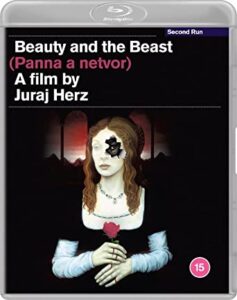
 BEAUTY AND THE BEAST, Juraj Herz, director/Second Run Few would argue that Jean Cocteau’s stunningly magical version of Beauty and the Beast remains the definitive cinematic take on the story, but the dominance of Cocteau’s version does not preclude impressively eccentric efforts from other sources such as Juraj Herz’s imaginative 1978 film adaptation. This sinister and atmospheric adaptation is at times a reminder that the director was responsible for The Cremator and Morgiana, And the same kind of imagination is at work here even if nothing in the film really rivals the poetic beauty of Cocteau’s version.
THE PSYCHIC, Lucio Fulci, director/Shameless When film buffs became aware of the multitalented Italian director Mario Bava, they were aware that he had worked in a variety of genres: the peplum (his work in a variety of Hercules films), the Western (although his westerns were little seen outside of Italy) and, principally, the giallo with his groundbreaking Blood and Black Lace being a progenitor of the entire genre. However, his colleague and compatriot Lucio Fulci was perceived in the UK as a maker of gruesome zombie movies – his earlier work took much longer to filter its way north. Now we have a chance to see one of his more interesting films, the relatively discreet The Psychic, which bears evidence in its command of suspense of Fulci’s admiration for the films of Alfred Hitchcock. Shameless offers Fulci’s The Psychic (aka Murder To the Tune of the Seven Black Notes) restored from new 2K-scanned materials. Jennifer O’Neill plays Virginia, a woman who has had psychic powers since childhood when she sensed her mother’s suicide… now disturbed by waking visions of bloody deaths and meaningless torment, she turns to her parapsychologist friend (Marc Porel). Fulci fans need not hesitate.
THE PEOPLE NEXT DOOR, David Greene, director/Indicator Cult director David Greene is finally receiving its due, as this Eli Wallach and Julie Harris-starring drama proves. The plot concerns a New York family struggling with drug abuse. Powerfully directed by Greene and shot by Gordon Willis, this is a very welcome UK Blu-ray premiere.
THE SERGIO MARTINO COLLECTION: THE CASE OF THE SCORPION’S TAIL, YOUR VICE IS A LOCKED ROOM AND ONLY I HAVE THE KEY & THE SUSPICIOUS DEATH OF A MINOR, Sergio Martino, director/Arrow Sergio Martino was one of the most energetic and vital of Italian genre directors. Born in Rome in 1938, Martino’s varied film experience finally led him to be established as a director of imagination, one prepared to take on the challenges of genre film-making and deliver something fresh and personal. He is best known as a director of grisly gialli, but there were no genres that held terrors for him, with Westerns, tough thrillers and even ribald comedies on his curriculum vitae. In one area Martino is very much like his compatriots Mario Bava and Dario Argento: while never being as consistently inspired in his work as them, he is capable of truly vivid and engaged film-making, alongside some by-the-numbers work. Probably the main influence on Martino was his contemporary Dario Argento, and La Coda dello Scorpione (The Case of the Scorpion’s Tail, 1977) was clearly influenced by the great international success of Argento L’Uccello dalle Piume di Cristallo (The Bird with the Crystal Plumage, 1969) and mimicked that film’s tortuous (and slightly improbable) plot. Your Vice is a Locked Room and Only I Have the Key (Il tuo vizio è una stanza chiusa e solo io ne ho la chiave, 1972), is an intriguing Martino entry. However… another Italian adaptation of Edgar Allan Poe’s The Black Cat? Well, it’s film that doesn’t have a great deal to do with Poe, but it’s an interesting effort, however hazy its antecedents (Lucio Fulci’s barely intelligible The Black Cat – see elsewhere — similarly took only the most glancing of nods at the original story) Your Vice is a Locked Room and Only I Have the Key, shares with Sergio Martino’s other gruesome and imaginative gialli a portentous, semi-poetic title, but the film, while flawed, is as visually impressive as all of his work. What’s the best way to approach Sergio Martino’s Suspicious Death of a Minor? Those looking for a blood-drenched giallo will find some elements of that genre in the film, delivered in customary Martino style (after the abrupt throat slitting of the first victim, there is a striking shot of the sinister killer’s face moving back from her fading vision and vanishing into darkness – Martino’s visual skills rarely deserted him). But if you’re a fan of the poliziotteschi — the tough, urban Italian crime thrillers – Suspicious Death clearly moves in that territory. Arrow’s The Sergio Martino Collection, with its quite superb transfers, is the perfect way for aficionados of the genre to acquire these quirky and mesmerising films.
JAGGED EDGE, Richard Marquand, director/Indicator The days when the fabulous amounts that screenplays by Joe Eszterhas would routinely glean seem a long time ago, and it’s not hard to see why people working in the same field were jealous of the stonking figures he was able to bank for such screenplays as Basic Instinct and Jagged Edge. Looked at in the 20th century, the latter remains a solidly made and highly efficient suspense movie, with committed performances by its two lead stars, Jeff Bridges and (most obviously) Glenn Close, who is at her considerable best here. If the screenplay seems efficient rather than inspired, that hardly matters – Joe Eszterhas’s bank balance is not an issue. What counts is that the film still wears well in the 21st century. Newspaper publisher Jeff Bridges is accused of murdering his wife, and Glenn Close plays the attorney with whom he has a affair. Richard Marquand’s film is mastered from the finest available materials, with impressive extra features.
CORRUPTION, Robert Hartford-Davis, director/Indicator Certain films in the British Gothic vein became (at one point) almost impossible to see because of continuing censorship problems (as much as rights issues), and in the 21st century, more people are familiar (if at all) with Robert Hartford-Davis’s Corruption (1968) from fuzzy grey-market video incarnations than cinema showings – until now, with this pristine Indicator transfer. The presence of the estimable Peter Cushing in Corruption is surprising; the film, the umpteenth remake of Franju’s Les Yeux sans Visage (with a coolly demented doctor attempting to restore the beauty of a mutilated loved one) is sometimes uncomfortable to watch given the amount of unrestrained, bloody flesh-ripping that Cushing is called upon to do; Cushing is engaged in a lengthy struggle with a prostitute, ending in multiple stabbings with, finally, a sexualised murder. This is followed by a graphic, unhurried decapitation. The doctor leaves the room with the dead woman’s head in his bag, and the camera finally rests on the headless body of a doll. When watching this scene – shot for the ‘continental’ version — it’s easy to see why the actor was the uncomfortable making the film). But it is essential viewing for Cushing admirers – and those of a non-squeamish nature.
WILD SEARCH, Ringo Lam, director/Eureka The charisma of cult actor Chow Yung Fat is fully on display in this hard-boiled thriller from the director who made his name with such stunning efforts as City on Fire. What distinguishes this one is its strongly pronounced romantic streak, played for all its worth by Chow Yun fat and Cheri Chung. this third collaboration between star and director has Yun fat playing a widowed police officer on the trail of a gang of gun runners; the hard-boiled copper finds that he must protect a young girl from a implacable gang seeking her death. There are elements here of Peter Weir’s film Witness, but Lam is very much his own man.
TRUE ROMANCE, Tony Scott, director/Arrow When the cult of Quentin Tarantino assumed the epic proportions that it has acquired more recently, it was inevitable that admirers would seek out earlier work that may have passed them by. Of course, many people were aware of the kinetic ambitious reach of Tony Scott’s flawed but fascinating True Romance (written by Tarantino), but it’s useful even for those who remember it from the first time round to see the film in the impressively spruced-up transfer from Arrow to relish anew Scott’s command of cinema as well as Tarantino’s priceless dialogue. Impressive action set pieces and terrific performances are another plus in this 4K transfer with copious bonus features.
HAMMER VOL.6: NIGHT SHADOWS, various directors/Indicator Admirers of the output of the Hammer studios are well aware that horror was only one aspect of their output, with psychological suspense and economically made swashbucklers (not to mention lurid historical dramas) produced by the company at the height of its fame. The bijou label Indicator has put admirers of the genre into its debt by issuing handsomely packaged boxes covering a variety of the company’s excursions into various genres, and the splendidly detailed transfers that they specialise in show such films to the best possible advantage. The latest offering is a particularly valuable one, collecting some neglected films. After Hammer Volume Five’s sampling of action and adventure, Night Shadows tackles the studio’s horror and thriller work, with four films made in collaboration with Universal Pictures. Edgar Allan Poe figures Shadow of the Cat, with André Morell and Barbara Shelley; Peter Cushing and Oliver Reed do sterling work in Captain Clegg, while Herbert Lom is the eponymous Phantom of the Opera in an underrated Hammer version of Leroux’s novel, while Freddie Francis helms Nightmare in the Boileau/Narcejac vein. All Catnip for Hammer fans.
FRANCO NOIR coming from Severin in October Following his international breakthrough with THE AWFUL DR. ORLOFF, director Jess Franco next delivered a startling pair of crime-thrillers that pistol-whipped European notions of film noir while lighting the fuse on Uncle Jess’ own insane aesthetic. Set in New Orleans and based on a novel by the authors of VERTIGO, DEATH WHISTLES THE BLUES is a hard-boiled tale of betrayal, violence and revenge featuring smoky jazz compositions by Franco himself. Jean Servais of RIFIFI fame stars in RIFIFI IN THE CITY, a nihilistic trip through a pulp underworld of thugs, snitches, nightclub dames and black-gloved giallo-style murders. Both films – which led an impressed Orson Welles to hire Franco as his assistant on CHIMES AT MIDNIGHT – now feature HD scans from the original negatives for the first time ever.


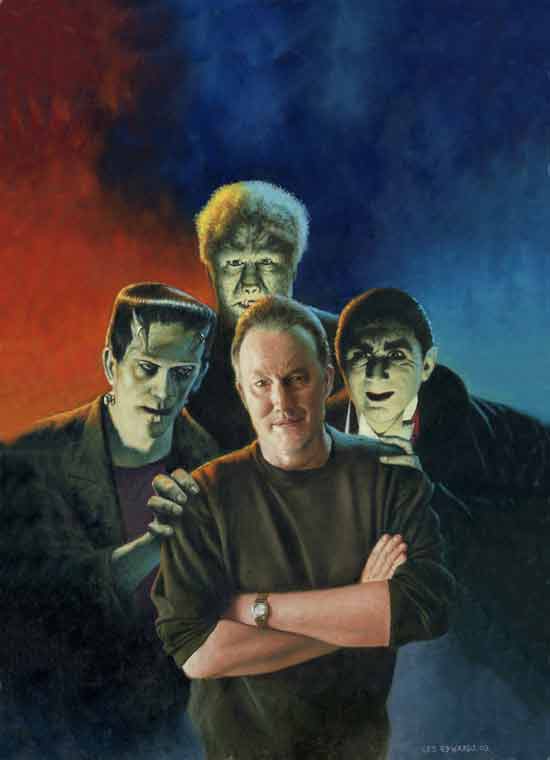 Stephen Jones is not just the U.K.’s leading horror anthologist. For some considerable time, Jones (seen above with friends in a portait by Les Edwards) has been a chronicler of those within the fantasy, horror and SF genre who have shuffled off this mortal coil – as the new Alchemy Press Book of the Dead reminds us. The sadly departed talents within this latest volume include the man who helped create Godzilla, two British actresses who were both Bond girls and also Avengers (British variety), and – as the blurb says — the screen’s best James Bond. (You’ll have to purchase the book to see who fits that particular description, as if you didn’t know). Copiously illustrated, the book is – counterintuitively – extremely enjoyable reading rather than a morbid examination of departed individuals. But be warned, you may pick this up thinking that you will be just dipping into it – and you will find yourself glued to the pages. And if you have personally made a significant contribution to the horror, SF or fantasy genres, perhaps you should read it to see if you are still in the land of the living. Barry Forshaw