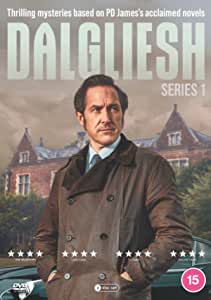
DALGLIESH, various directors/Acorn Media A welcome silver disc release for the recent Channel 5 iteration of Adam Dalgliesh, PD James’s durable detective/poet, with the actor Bertie Carvel following in the footsteps of Roy Marsden whose long-running series pleased many fans (although not – totally – Dalgliesh’s creator, as PD James once confided to me). There was also, of course, the shorter (and markedly less popular) series with Martin Shaw; recent showings of the latter have afforded viewers a chance to reassess Shaw’s performance. So is Carvel’s Dalgliesh winning over James aficionados? Approaching the new series, the actor noted in a magazine interview that his series begins with Dalgliesh mourning his wife and child.
‘Our overall story arc is about the first year of grief’, he said. ‘Actually, that wasn’t clear initially and I lobbied quite hard that the three stories should all fall in the same year. My personal journey (as the Inspector) is about coming to terms with — or to begin a journey of – processing this loss. He’s somebody who deals in and spends time thinking about death and is kind of overly poetic about it. This year when he’s lost his wife and child, he finds himself having to prosecute these investigations which he takes great pride in. To me that seemed to give it much more weight than, “What murders do we solve today?”’
So…has Carvel succeeded in these laudable aims? The actor’s creative associates make a canny choice for the first adaptation. Famously, Shroud for a Nightingale begins with a gruesome murder in which a nurse who has volunteered to be a patient for student nurses has a gastrostomy tube pushed down her throat — but one in which carbolic acid is added to the warm milk, leading to a deeply unpleasant death (the series is a reminder – in an age when cosy crime with its sanitised murders is enjoying a commercial comeback — that James was never really a cosy writer). In the new version of Shroud adapted by Helen Edmundson and directed by Jill Robertson (with a subtle feminist slant; some play is made with a copy of Simone de Beauvoir’s The Second Sex, and only one male on view is not sleazy and predatory: Dalgliesh), the appearance of Bertie Carvel’s saturnine copper is initially encouraging; he is physically closer to James’s character than Marsden, and while not the most charismatic or expressive of actors, he conveys the cool ratiocination of Dalgliesh in a satisfying manner; we quickly feel that we are in reliable hands. Playing a relatively reined-in character like Adam Dalgliesh is a considerable challenge, of course – the detective is not able to openly display his emotions, and the other actors often have showier parts. Carvel manages to find Dalgliesh’s peculiar insularity, suggesting the loneliness. However, there is one area in which Marsden was more persuasive: as viewers, we are always studying Dalgliesh’s reaction to the things that people are saying to him — and Carvel doesn’t quite match Marsden in conveying things in a non-verbal way, things the audience can read in his eyes. Nevertheless, it is a solid assumption of the part, even if — as his sexist, none-too-intelligent assistant DS Masterson — Jeremy Irvine is encouraged to play the part rather broadly. And the necessity of fitting the episodes into time segments with frequent commercial breaks means that the storytelling is direct and brisk (some scenes, such as the pursuit of a nurse who has run in panic from the scene, have no setup – we simply cut to Dalgliesh in pursuit of her). So, if Marsden remains the gold standard, this new iteration of PD James’s intuitive sleuth — while solid rather than innovative — will please many.
DILLINGER, John Milius, director/Arrow Earlier attempts to film the life of one of the most iconic of American gangsters had made their mark, but it took John Milius in his debut film to furnish this nigh-definitive take on Dillinger’s life, a film considerably enhanced by the performance of the always watchable Warren Oates in the title role. It’s also something of a calling card movie for Milius, who apart from his own stellar contribution, is considerably aided by a highly impressive cast: Oates, Ben Johnson as his pursuer, and with strong support from Harry Dean Stanton, Richard Dreyfuss and Michelle Phillips of the Mamas and the Papas. The Blu-ray restoration features several revealing interviews.
AN UNSUITABLE JOB FOR A WOMAN, Chris Petit, director/Indicator Adapted from P D James’ celebrated crime novel, this intriguing film was directed by filmmaker and novelist Chris Petit. For readers of a certain generation, the name Chris Petit evokes particularly percipient film criticism in the pages of the London magazine Time Out, but the ambitious Petit persuaded the German director Wim Wenders to facilitate the British director’s debut film Radio On in 1979. This was a truly unusual and ambitious piece of work, presenting an almost Antonioni-like vision of an urban Britain as bleakly existential (and uningratiating) as the British cinema had seen. The intelligent adaptation of the James’ An Unsuitable Job for a Woman in 1981 was a version that much bemused the novel’s author, but is a very characteristic Petit film, with Pippa Guard as a tyro private detective who looks into the suicide of a young man but encounters menacing family secrets. The film was followed by two cryptic but mesmeric films, Flight to Berlin in 1983 and the challenging Chinese Boxes a year later.
THE LOVE OF JEANNE NEY, G.W. Pabst, director/Eureka Widely considered to be one of the greatest directors in the history of cinema, the work of G.W. Pabst is known these days mostly to cinéastes, but such companies as Eureka are making his neglected films available again in splendid new editions, such as this story of a young Frenchwoman in post World War I Europe. It’s also intriguing for those who only know the actress Brigitte Helm as the robot Maria in Fritz Lang’s classic Metropolis to see her in something other than that film.
THE MANGLER, Tobe Hooper, director/Arrow Blu-ray The packed career that beckoned for director Tobe Hooper after the succés de scandale of The Texas Chainsaw Massacre was, famously, not to happen – at least not in the form that he might have come to expect. Nevertheless, his rough, off-the wall talent was to resurface in such films as The Funhouse, and here’s a chance to reassess another one of his more neglected films, The Mangler, with Hooper again sampling (after Salem’s Lot) the writing of Stephen King with this gaudy black comedy. The Blu-ray is festooned with extras including new commentaries, archival interviews and a collector’s booklet.
HOFFMAN & THE BLOCKHOUSE, various directors/Indicator Impossible and diva-ish though he may have been to work with, the temperamental and erratic Peter Sellers was nevertheless one of the most mesmeric actors this country has ever produced, and admirers of the late star are always keen to track down his various films, from the successful to the misfires. Here, Indicator have afforded us a chance to see two of his less successful (and neglected) films, both of which nevertheless demonstrate his considerable range. And although it might be argued that neither film hits the mark, Sellers’ fascinating presence alone makes them very watchable. Indicator has announced that the company will no longer concentrate on the UK, but will be releasing in the US and Canada, too. The above films are early recipients of this new approach.
CAVEAT, Damian McCarthy, director/Acorn Media International The horror genre is distinctly overcrowded at present, so something special is required to rise above the fray. In terms of imagination and visual panache, Damian McCarthy’s constantly involving Caveat really does deliver the goods as amnesiac drifter Isaac (Jonathan French) attempts to recall his recent past after a traumatic event. An isolated house is found to contain horrors.
ECHOES OF THE PAST, Nicholas Dimitropoulos, director/Reel 2 Reel Films If The late Max Von Sydow had only appeared in the films of the Swedish master Ingmar Bergman, he would still be regarded as one of the world’s greatest actors – and certainly a consummate screen actor. But he did, of course, also enjoy a highly successful career in the American cinema (most famously, in the title role of The Exorcist). With such a career-high achievement behind him, it’s good to report that his final performance proves to be one of his best in director Nicholas Dimitropoulos’ remarkable drama. Inspired by true events – one of the darkest moments in modern Greek history — this is the first film to explore the Kalavryta Holocaust and the infamous massacre of Kalavryta by Nazi troops on December 13, 1943. The last survivor of the tragedy, Nikolaos Andreou is played by the matchless Von Sydow.
THE DEVIL’S MEN, Kostas Karagiorgis, director/Indicator If we discount the expat Boris Karloff, most film commentators would say that Christopher Lee was Britain’s most successful actor in the genre of horror films. But the UK has produced other splendid performers – and Peter Cushing may well be the very best exponent of the genre, usually managing to steal scenes from his friend in the many films they made together. His part in Kostas Karagiorgis’s supernatural drama does not take up much of the film’s running time, but (as always) he makes every moment tell – and the film also offers another great British actor, Donald Pleasance (known for considerably more than his horror film work), so aficionados will have plenty to keep them occupied. The Devil’s Men (also known as Land of the Minotaur) features a score by no less than Brian Eno. And this tale of a Satanic cult also features some spectacular Greek location shooting
SAILOR SUIT AND MACHINE GUN, Shinji Somai, director/Arrow It’s hard to imagine a film such as this being made in any other country than Japan, with its extremely quirky mix of genres. The bizarre result is a mix of the yakuza crime film and the teen movie, finessed by playing that negotiates the straightforwardly comic and taken-at-face-value dramatics. The result will not be to every taste, but for those receptive, a diverting time is guaranteed A high-school girl faces up to gangsters in Sailor Suit and Machine Gun, a version of Jiro Akagawa’s bestselling novel directed by Shinji Somai (famous for such films as Wait and See), a key figure in Japanese film. The film is presented in both its original theatrical and longer complete versions.
Forthcoming from Imprint/ViaVision: DAY OF THE DEAD: a world first on Blu-ray – the new TV series inspired by the work of George A. Romero. A stunning 1080p High Def presentation inspired by Romero’s 1985 film of the same name and one of the most popular horror franchises of all time, Day of the Dead is the intense story of six strangers trying to survive the first 24 hours of an undead invasion. This ode to Romero’s famous flesh-eaters reminds us that sometimes all it takes to bring people together is a horde of hungry zombies trying to rip them apart.
Forthcoming from Blue Underground: THE TOOLBOX MURDERS: in 4K Ultra HD. Blue Underground rings in the New Year with one of the most controversial of horror films: a much-spruced-up new release of The Toolbox Murders. Dennis Donnelly’s notorious exploitation classic makes its debut on 4K Ultra HD with a new Blu-ray combo that has been scanned in 4K 16-bit from the uncut original negative. Despite various attempts at censorship, the film has developed a devoted cult following in the decades following its release.