

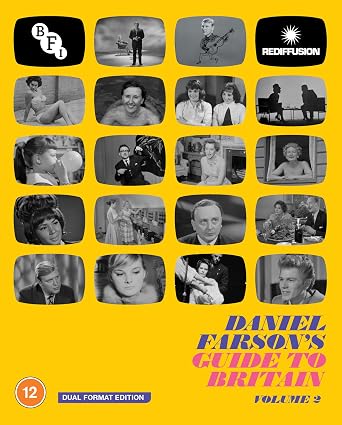
 You will need to be a certain age to remember the contribution that Daniel Farson made to the television landscape in the late 1950s. In manner, Farson might have struck the viewer as part of the patrician class commentators most likely to be seen on television in that era, but there was more to him than that – Farson possessed what we would now regard as a slightly counter-cultural attitude that played interestingly against his cut-glass accent, and his readiness to tackle then-unorthodox subjects was notably ahead of its time. This second collection of his short documentaries is welcome as a cultural artefact of its times (including sexual themes). Highly entertaining, and proof of the BFI’s descriptive strapline: ‘Brash, bohemian and boozy, bon vivant ITV reporter and presenter’; the first programme on nudism is priceless in its humour, but there is much sharp social commentary in these pieces.
Blu-Ray Highlights
DANIEL FARSON’S GUIDE TO BRITAIN VOLUME 2, BFI
John Flynn’s THE OUTFIT from Arrow
 THE OUTFIT, John Flynn, director/Arrow
While Donald Westlake’s achievement as a crime writer is legendary, many readers have a sneaking regard for the cold, spare Parker novels he wrote under the pseudonym of Richard Stark. Rarely was a nom de plume so well chosen: the Parker books, with their ruthless, largely unemotional mob hitman as a central character, are truly existential enterprises – everything is stripped away that does not facilitate the fast-moving plot. In The Hunter (now better known by the title given to its celebrated film adaptation, Point Blank. Parker (renamed as Walker) is shot and left for dead. Is the character played by Robert Duvall in the earlier The Outfit Parker? Yes, he is, although he is renamed here Earl Macklin. This brutal and diamond-hard outing is one of the great modern films noir, directed with energy and precision by the talented John Flynn, The always reliable Duvall is backed up by a solid supporting cast: Joe Don Baker, Robert Ryan. Karen Black and other luminaries. The set pieces are among the best that American cinema has to offer.
Buñuel’s EL from Radiance
Barry Forshaw
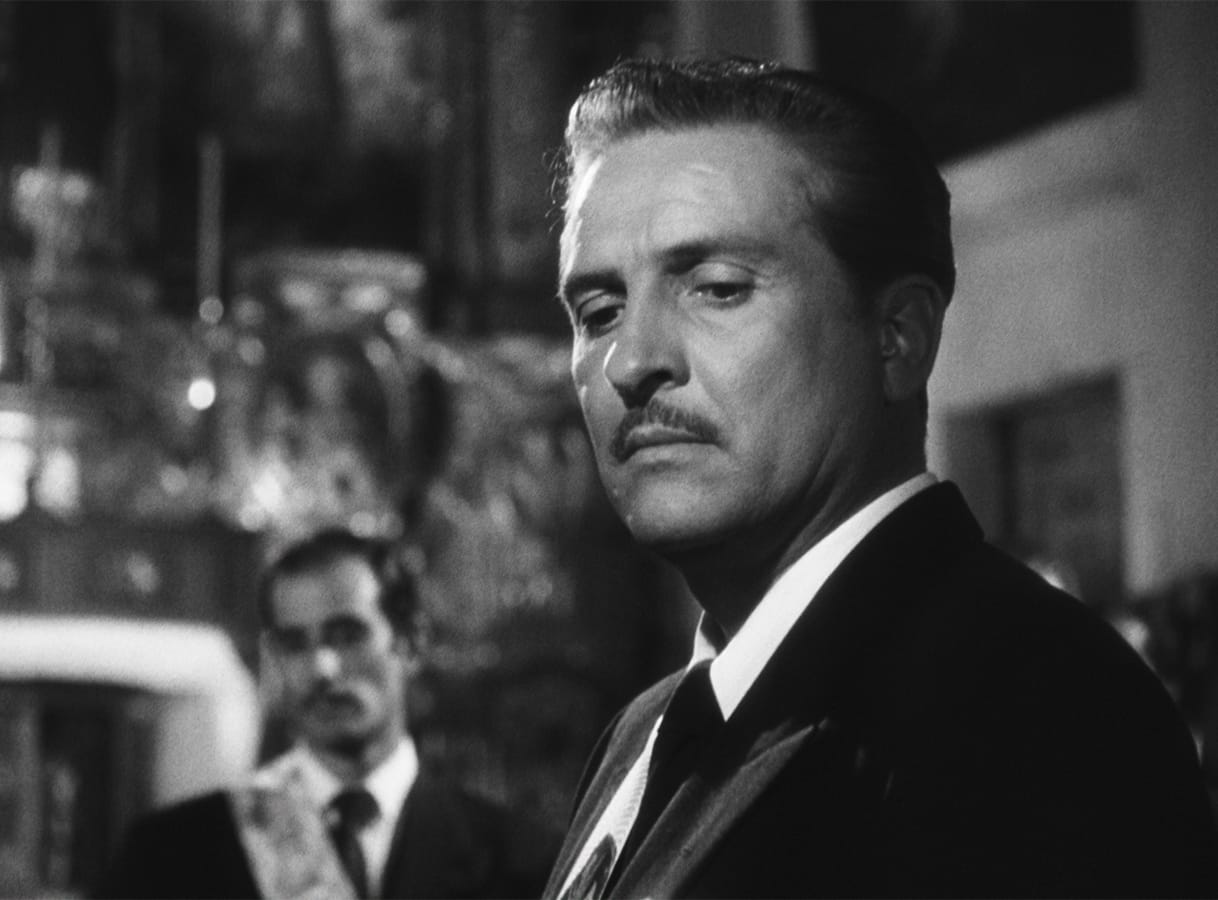
El, Luis Buñuel, director/Radiance
A key work of his Mexican period, Buñuel’s sardonic and transgressive drama has pre-echoes of his later films with its dark humour and surrealist underpinnings; it’s a little-seen curio from a giant of international cinema. In recent years, the more difficult-to-see of Buñuel’s films have been making their way onto the silver disc medium and this chance to revisit one of the cinema’s great masters is much to be applauded. As the appearance of El attests, it’s not just the better-known classics such as Viridiana and The Exterminating Angel which deserve our attention. This new transfer from Radiance maintains the company’s impeccably high standards.
Van Helsing and His Kin by Daniel O’Brien
 Barry Forshaw
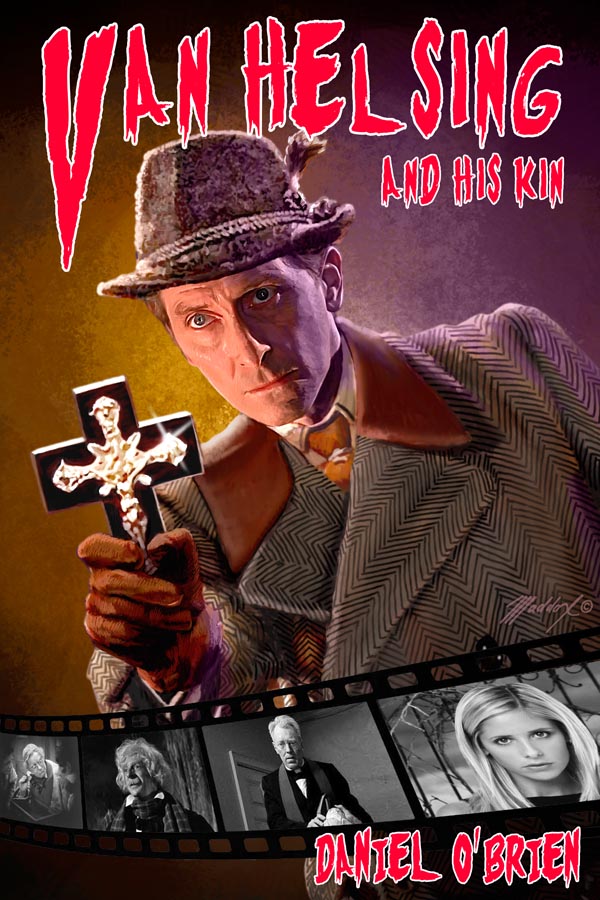
One might have thought that there were no areas of genre cinema which had been left untouched in terms of bookish studies (this writer has tackled a couple), but Daniel O’Brien seems to have a particular knack for finding subjects that invite investigation, as in his earlier book, Classical Masculinity, discussed below. The new one, Van Helsing and his Kin, takes a highly unusual premise and forges a scholarly but totally accessible study of an unusual subject. Van Helsing, of course, is the vampire hunter of Bram Stoker’s 1897 novel Dracula, and while people will be familiar with his bloodsucking nemesis, Van Helsing has long been the template for the forces of good ranged against those of evil. But as O’Brien notes, his progeny are many, extending even to Buffy, a vampire hunter of the modern generation. However, there is a positive army of such figures, and they have been played by actors from Edward Van Sloan and Peter Cushing as perhaps the cinemas Best known incarnations of the Figure and played by actors from Laurence Olivier to Hugh Jackman. The variety of iterations stretches far and wide, and in a book of 320 pages, O’Brien’s coverage is truly impressive – as is, of course, his informed and enthusiastic analysis of both ‘respectable’ and cheapjack versions of the character. It’s a fascinating read for those interested in the horror genre.
I wrote of O’Brien’s earlier Classical Masculinity and the Spectacular Body on Film: The Mighty Sons of Hercules : ‘Forget the unwieldy title and just marvel at the fact that academic writing on film can be as lively and stimulating as this! Daniel O’Brien — whose knowledge of Italian genre cinema is nonpareil — produces a remarkably allusive study of the cinema’s treatment of the muscular male physique (with particular attention to the Hercules movies directed by such talented auteurs as Vittorio Cottafavi and Mario Bava, as well as lesser talents such Pietro Francisci, responsible for the two Steve Reeves Hercules movies). O’Brien examines the fascinating subtexts of this oft-despised genre and its contradictory approaches to masculinity. What’s more, O’Brien performs a particularly impressive feat of prestidigitation, couching complex notions within prose that is always supremely readable.’
Van Helsing and His Kin by Daniel O’Brien is published by Telos
New from Hammer, BFI, Studio Canal, Indicator
Barry Forshaw
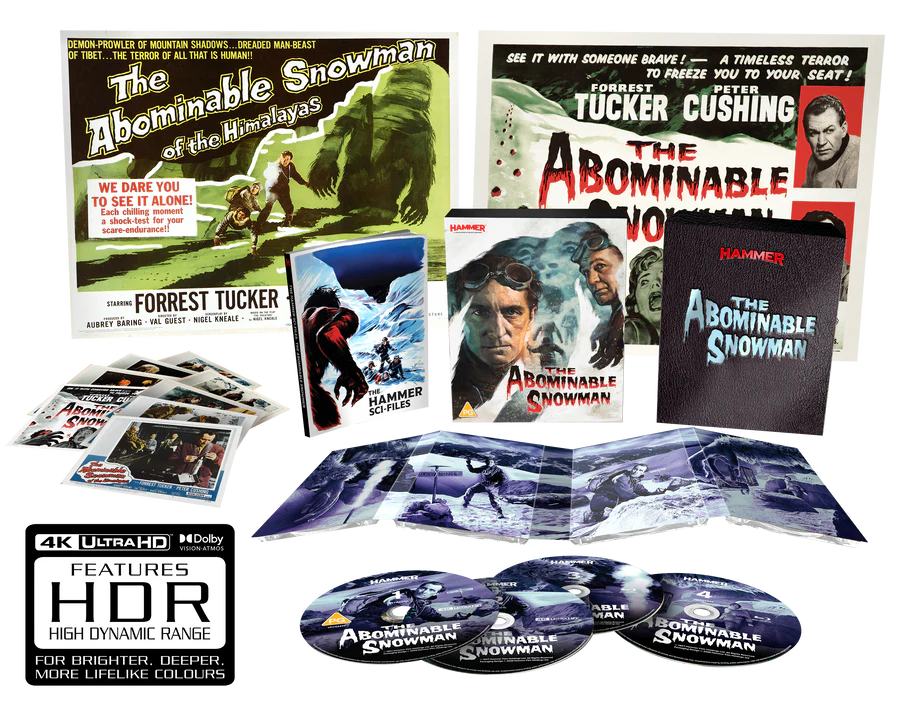
THE ABOMINABLE SNOWMAN, Val Guest, director/Hammer
The Real Monsters
It’s a pleasure to start with one of the most underrated (and, in fact, one of the most accomplished) of Hammer Films, the latest to enjoy the spectacular boxed set treatment. I’ve written a booklet essay for the set, and I quote: ‘For one of Hammer’s most intriguing and unusual films, the company turned to the ever-irascible, ever-creative Manx writer Nigel Kneale, who had supplied (via his groundbreaking television serial) the basic material for their first entry into the world of the macabre, The Quatermass Xperiment (1955). That film was very ably directed by the highly professional Val Guest (along with its sequel, Quatermass 2, once again featuring the bluff rocket scientist Bernard Quatermass) and Guest – who worked frequently for Hammer – was to prove one of the company’s most reliable craftsmen, along with their key director, Terence Fisher. While Kneale’s teleplay The Creature (1956), with its version of the snow-monster the Yeti, was somewhat different in its elliptical construction from his other work, there was no reason to suppose that with Guest in charge of the direction the company would not strike gold again. The Creature became the basis of The Abominable Snowman (1957; The Abominable Snowman of the Himalayas in the USA). Inevitably, of course, audiences might have expected that the titular mythical creature stalking the frozen wastes would be as murderous a threat as, say, the Mummy or Dracula. But this was not to reckon with the work of the inventive Kneale, always disposed to take an unconventional approach to his material…’
OBSESSION, Curry Barker, director/Universal/Spirit
Word-of-mouth is often a key factor in a film achieving cult status, and so that is proving with Curry Barker’s highly accomplished horror outing. After a successful theatrical run, Obsession arrives in 4K UHD Blu-ray. After using the mysterious “One Wish Willow” to win the object of his affection, a nerdy romantic gets his wish, but at a terrible cost. Performances are top-notch, particularly Inde Navarrette (of Superman & Lois fame), as the girlfriend gradually transforming into a monster. In fact, Navarrette’s performance is one of the most genuinely disturbing additions to the horror film genre the viewer is likely to have encountered.
ACCIDENT Joseph Losey, director/StudioCanal Blu-ray
Impressive though The Servant was, the finest fruit of the Losey/Pinter collaboration is undoubtedly Accident, a film in which the level of achievement matches that of the playwright’s work in the theatre and – what’s more — even aspires to the kind of arthouse filmmaking on British soil that was already characteristic of Bergman in Sweden and Antonioni in Italy. And the matchless cast does perfect justice to Pinter’s text – not just Bogarde, but also Stanley Baker (who had worked on Losey’s crime classic The Criminal), who was moving into what would be his abbreviated middle age as a fine character actor. This new restoration is stunning.
LAST HOUSE ON THE LEFT, Wes Craven, director/88 Films
Despite his reputation for extreme violence, Was Craven was one of the most intelligent and penetrating of directors, and this welcome issue showcases the director’s most groundbreaking film,: the once-banned Last House on the Left (based on Ingmar Bergman’s The Virgin Spring – the reference shows the ambitiousness of the director), Last House on the Left announced the arrival of two filmmakers, Sean S. Cunningham (Friday the 13th) and Craven (Nightmare on Elm Street, Scream) and it remains as potent – and as disturbing – as ever it was. 88 Films have issued a completely uncut transfer with impressive extras.
ROSE OF NEVADA, Mark Jenkin director/BFI
The Cornish director Mark Jenkin is unique among his contemporaries for both his very individual cinematic vision and notably low-tech use of the medium – as in this intriguing supernatural outing In which a fishing boat that disappeared with all hands decades before makes a modern appearance in the harbour of a Cornish village. With the idiosyncratic playing of the actors here perfectly in tune with Jenkins’ unique approach, this is a remarkable film which once again boasts Jenkin as writer, director, director of photography, editor, sound designer and composer; extras include an audio commentary by Jenkin and Mark Kermode, and a filmed Q&A with the director, George MacKay and Callum Turner from BFI Southbank.
ZULU DAWN, Douglas Hickox, director/Severin
The considerable success – both critically and commercially –– of Cy Endfield and Stanley Baker’s remarkable Zulu – a pulse-raising evocation of the Battle of Rorke’s drift – perhaps ensured that the notion of a sequel dealing with other aspects of Britain’s past in colonial Africa was inevitable. In fact, Baker and Endfield made considerable efforts to bring about this project. However, by the time Zulu Dawn was actually made, Baker had died and Endfield found his contribution considerably slimmed down. Nevertheless, the resulting film was a remarkable achievement if perhaps lacking the intensity of its predecessor. Certainly, Zulu Dawn is a showcase for a host of the very best British character actors, and this new iteration. Of the director Cy Endfield, I wrote ‘The House Unamerican Activities committee did British cinema a favour by consigning left-leaning directors such as Endfield to professional exile in the UK in the 1950s. Like Joseph Losey, a key casualty of the communist witch-hunt was Endfield, who produced excellent work when exiled to Britain.
X THE UNKNOWN, Leslie Norman director/Hammer
When Nigel Kneale made it clear to Hammer Films that they could not go off at a tangent with his Quatermass character (apart, that is, from the three official adaptations of his original television science fiction dramas). The company, never one to miss a strong commercial opportunity, sanctioned this exceptionally well-made outing with Dean Jagger playing a similar figure to Kneale’s scientist investigating a monstrous creature which can now be seen as in the line of the American film The Blob and the Italian Caltiki. Restored from original film elements by the teams at Hammer and Silver Salt Restoration, this is a limited collector’s edition 4-disc 4K UHD and Blu-ray set that delivers remarkable clarity.
WEST SIDE STORY, Robert Wise, director/MGM 4K
Given that Steven Spielberg is one of the most considerable directors at work today, there was a dual response to his suggestion that he would be remaking Robert Wise’s version of Leonard Bernstein and Stephen Sondheim’s groundbreaking West Side Story. Foolhardy? Well, the remake was a perfectly serviceable crack at the show, but couldn’t begin to hold a candle to what is many people’s favourite musical – Robert Wise and Jerome Robbin’s 1961 film – and certainly the defining musical of the modern era. This new 4K iteration of the Wise film is quite breathtaking, not least for the multi-channel soundscape that this much enhanced version has. Whatever version you have of the 1961 West Side Story, it is now re rendered redundant by this new version. From his early days as a director of atmospheric horror films as part of producer Val Lewton’s team up to his mega-successes such as The Sound of Music and West Side Story, Robert Wise was long one of the most reliable (and frequently inspired) directors in Hollywood (a particular favourite of many Wise admirers is his subtle and allusive treatment of the Shirley Jackson novel filmed as The Haunting. But West Side Story is Wise at his impeccable best.
CRUEL TALES OF THE BOHACHI, Teruo Ishi, director, Eureka
The Eureka label has made something of a speciality of issuing top notch samurai exploitation films from the influential Golden Age of Japanese cult cinema in eye-popping new iterations, and Cruel Tales of the Bohachi, directed by the highly capable Teruo Ishi, is an energetic additions to the company’s catalogue. The film keeps all the colour and inventiveness of the original manga by the Lone Wolf and Cub creators. Eroticism and violence are always to the fore in entertaining fashion.
JOE, John G Avildsen/Indicator
This unique outing by the underrated director John G Avildsen makes for fascinating watching in the 21st century. Its plot – reminiscent of John Milius’s Hardcore – in which a father attempts to save his daughter from the destructive lifestyle she has sunk into – was much discussed in its original release The abrasive character of the eponymous Joe (played in mesmerising fashion by Peter Byle) is a blue-collar Right-wing Figure who helps a father (Dennis Patrick) in his crusade ending in bloody fashion. But was Avildsen secretly on the side of Joe, or did he regard him as dangerous monster? . Or both? That decision is still left to the viewer, and the film still packs a considerable punch.
IL MOSTRO, Luigi Zampa, director/Radiance
Radiance continues to add intriguing and little-seen Italian films to its now considerable itinerary, and this new release brings further lustre to the company’s already banished reputation. Luigi Zampa’s is a sardonic approach to the genre, with some social commentary on the function of the press. Playing and direction here are nonpareil, and admirers of Italian cinema need not hesitate.
LAST TANGO IN PARIS, Bernardo Bertolucci, director/88 Films
In terms of the stretching of parameters concerning the representation of sex on film, the 1970s was the decade of Bertolucci’s controversial Last Tango in Paris (1972), though the sex between the Marlon Brando and Maria Schneider characters was simulated; what’s more, the desperately nihilistic misogyny of the male protagonist seemed to inform the whole film, and despite the upset it caused (notably the scene in which Brando uses butter on the Schneider character to facilitate penetration), the film’s attitude to sex is markedly ambiguous. Bertolucci, from his earliest films to his most recent, had shown an uninhibited readiness to deal with human sexual activity (e.g. in such films as The Dreamers made in 2003), but nothing else in his career caused such a fuss as Last Tango in Paris. The various attempts at prosecution of the film brought it to the attention of many people who would not otherwise have heard of it. Bertolucci’s sombre, despairing film is really the study of a personality in disintegration – a middle-aged American widower’s doomed love affair with a vulnerable young French woman, and Marlon Brando’s alternately volatile and lachrymose performance is characteristically hypnotic. The sad real-life decline of Maria Schneider led to Bertolucci saying that he wanted to ask forgiveness from the actress. The film has elements of a cinematic version of Wagner’s Tristan und Isolde; the ‘Liebestod’ here; while not seeing its trajectory to quite the same fatal conclusion, echoes the composer’s marriage of love and death.
DJANGO SHOOTS FIRST, Alberto De Martino, director/Studio Canal
This entry in the long running Django series (of which many films feature a character who has nothing to do with the original Franco Nero outing) is more tongue-in-cheek than most, and features the Dutch actor Roel Bos (who changed his name for the film to Glen Saxson) and delivered a lively bounty hunter story with frequent action sequences – and unlike American treatment of such a character in frequently negative fashion, the attitude to Django’s profession is balanced. The transfer is eye-popping.
PAINTED FACES, Alex Law, director/88 films
Apart from the nicely observed playing here (particularly from Sammo Hung as the director of a group of children training for theatrical experience), one of the pleasures of the film is the rather beautiful cinematography which presents a world which will be unfamiliar to most viewers. For those seeking something off the beaten track, Painted Faces can be confidently recommended — although it should be pointed out that those expecting the usual acrobatic violence from the rotund Sammo Hung should perhaps look elsewhere – this is another side of his personality. The kung fu legend takes a rare dramatic role as the tough master Yu, a teacher training young kids for a life on the stage. Based on the real-life childhoods of Jackie Chan, Yuen Biao and, yes, Sammo himself (he’s playing his own, real-life master), Painted Faces is a nostalgic tribute to a man who turned children into superstars.
OH! WHAT A LOVELY WAR, Richard Attenborough, director/Eureka
The great era of the musical was over by the time that the actor Richard Attenborough made his directing debut with this remarkable record of Joan Littlewood’s anti war theatrical project; however, like Cabaret, the film was not seen as a standard musical and had a much wider reach than most films in the genre. With a cornucopia of British stars, this is a film that looks even better with the years, and is particularly enhanced in Eureka’s Splendid new transfer.
OUTLANDER SEASON 8 & OUTLANDER: THE COMPLETE SERIES 1-8 Elevation
on Blu-ray™ and DVD
Based on the best-selling books by author Diana Gabaldon, Season 8 of Outlander the time-traveling, fantasy romance sees the epic conclusion of the hugely popular TV series in which Claire (Caitríona Balfe) and Jamie (Sam Heughan) experience a heart-wrenching journey as they return to Fraser’s Ridge after leaving the Revolutionary War and are met by new arrivals and changes to their community made during their years away. Fraser’s Ridge is now a thriving settlement, flourishing without the Frasers or their influence now for some time. The Frasers soon learn that leaving the war behind is not as easy as they believed and are soon confronted with the question of what they are willing to sacrifice for the place they call home and more importantly, what they would sacrifice to stay together.
Whistle Down the Wind by Josephine Botting

Barry Forshaw
‘British cinema doesn’t seem quite sure where to place Whistle Down the Wind. It’s certainly not the crime drama it was originally marketed as, nor the children’s film it’s often dismissed as. Would it receive more attention in academic circles if it was inducted into the British New Wave?’ These questions concerning one of the best-loved of British films – a memorable drama in which a group of children in a rural setting discover a murderer hiding in their barn and mistake him for Christ – are posed by one of the most astute of British film commentators, Dr Josephine Botting, in a scholarly but accesible volume written for the BFI Film Classics series. The reputation of the 1961 film has grown over the years, and it has long been beloved of those who encountered it in their youth, not least for the impeccable performances by a young Hayley Mills as the leader of the children and Alan Bates (his film debut) as the criminal who is the recipient of that innocent help. Despite these manifold virtues, however, there is no denying that much of the success of the film is down to the sensitive and perceptive directorial treatment by then-debut director Bryan Forbes, a truly important British filmmaker who is only now receiving the kind of attention that his skills in a variety of genres have long called out for. And such attention is enhanced by this loving study. Josephine Botting is a curator of the BFI National Archive and a programmer at the BFI South Bank, overseeing the monthly ‘Projecting the Archive’ initiative. She is the perfect chronicler of how this remarkable film came to be — and she is perceptive as a commentator on the career of its director.
Bryan Forbes was one of the reliable, multi-talented professionals of British film; not quite displaying the brio of more coruscating talents, but always producing solid, accomplished and frequently inspired work in whatever field he was essaying, be it acting, directing or writing (the last of these three may be his most pertinent legacy for the cinema; the acting was quickly sidelined when his behind-the-camera skills proved more impressive). Born in Stratford, Forbes’ original ambitions lay in the acting realm, and he underwent training at RADA, but left before the completion of his final term. Initially making his mark as an actor in films (including in Michael Powell’s The Small Back Room in 1949), Forbes then began to exercise his nascent skills as a writer and director. His first significant success was the witty and artfully constructed screenplay for The League of Gentlemen (1960; directed by Basil Dearden), with its ingenious heist committed by a group of alienated ex-servicemen led by Jack Hawkins. Success in other fields followed (such as the gentle, wistful drama Whistle Down the Wind and the quintessential kitchen-sink film The L-Shaped Room (1962), with Leslie Caron considering an abortion). Other films in the crime genre were to follow, such as the flawed but interesting Deadfall (1968) with its vaguely Du Rififi Chez les Hommes-style robbery. The versatile Forbes’ secret (apart from his considerable screenwriting skills) was his fellow-feeling sympathy for actors, and all of his films feature some exemplary work from the group he always continued to regard himself as part of – the thespian community. The most oft-used member of that community (who featured in many of his films) was Forbes’ wife, the actress Nanette Newman.
If Jo Botting’s concise and perceptive tome on Whistle Down the Wind accrues the attention the film deserves – along with Paul Moody’s concurrent study of Bryan Forbes’ The Stepford Wives (also from BFI Film Classics) – the establishment of the director’s name in the pantheon of British talent is assured.
Whistle Down the Wind by Josephine Botting is published by BFI Film classics