

Barry Forshaw of The Financial Times
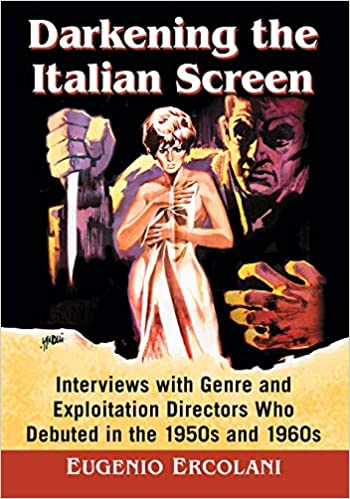
Darkening the Italian Screen by Eugenio Ercolani (McFarland) Eugenio Ercolani’s detailed and informative study moves into some very under-recorded areas of Italian cinema, including filmmakers who will be unfamiliar to most (even this writer — and I modestly consider myself something of an authority in the field!). Almost from the beginning, Italian film has had two coexisting strands, one respectable and one thought (wrongly) by many Italians to be meretricious and unworthy of serious attention: the ambitious, artistically serious film — and the catchpenny exploitation movie in a variety of genres. While the former has produced some of the finest auteurs in the cinema, Italian popular fields might also be said to have furnished some remarkable, unorthodox talents who quickly stretched the parameters of the popular areas they worked in, be it the muscleman ‘sword-and-sandal’ epics, the Western, the thriller or the horror film. In terms of the these arenas, it might be said that the Italian exploitation cinema had by the 1990s simply shut up shop and only intermittently produced the kind of startlingly innovative imitations of American or British cinema that were once the sine qua non. Ercolani has managed to obtain completely frank discussions with the vintage makers of horror, Gialli and poliziotteschi/detective thrillers, but perhaps this frankness was not so difficult to obtain, given that Italian filmmakers have long been frank about disputes in their collaborations – and some of the point-scoring here about fallings out and betrayals are extremely entertaining, whatever the rights and wrongs of the long-ago confrontations. The final effect of the book (like the work of Ercolani’s countryman, Roberto Curti) is to send aficionados out to track down some of these films, and it’s a shame that the great majority of them have yet to appear in subtitled Blu-ray editions (though companies such as Arrow are doing sterling work). Famously, the Italians do not take their own genre contributions as seriously as other countries (Pietro Francisci’s highly influential Hercules movies, for instance, have never appeared on Blu-ray in their country of origin), but Ercolani’s book may go some way to redressing the balance.
52 More Must-See Movies and Why They Matter Volume 2 by Jeremy Arnold (Running Press). Apart from its sharp and incisive writing, there are several ancillary benefits to this follow-up to an earlier (and equally stimulating volume). The principal one, of course, is to send the reader back to some of these cannily chosen classic movies, from Psycho to The Producers to 2001: A Space Odyssey. With particularly well chosen stills and striking design, Jeremy Arnold’s book will be catnip to admirers of the cinema. Along with the earlier volume, 52 More Must-See Movies makes a cherishable addition to the library of film books. Needless to say, the writing here is not of the scholarly variety, more the popular market voice of a cinema enthusiast – and there is certainly room for both kinds of writing on film.
A Light in the Dark: A History of Movie Directors by David Thomson (Weidenfeld) David Thomson’s publishers are right to use John Banville’s encomium on the jacket of A Light in the Dark: A History of Movie Directors – Thomson really is ‘the greatest living writer on the movies’. The new book is relatively brief (given the doorstop-sized volumes that he has produced in the past), weighing in at a modest 240 pages. But how forensic and stimulating Thompson is regarding the directors he chooses to discuss! They include Fritz Lang, Luis Bunuel, Howard Hawks, Nicholas Ray, Orson Welles, Jean Renoir, Jean-Luc Godard and – of course – Alfred Hitchcock, as well as contemporary powerhouses such as Jane Campion, Spike Lee, and Quentin Tarantino. Thomson’s book, however, is no mere rehearsing of previous notions the writers has expressed about these talents, although he touches on familiar territory – there is, however, much new thinking, taking into account changes in both film criticism and society notably (in the case of Hitchcock), a more proscriptive attitude towards directors whose sexual attitudes may not chime with currently accepted orthodoxies. Readers will be intrigued by the strangely schizophrenic (in the old sense) nature of Thomson’s thinking: there are thinly veiled attacks on ‘wokeness’ and political correctness, but there is also (counterintuitively) a chapter on the male gaze that could have been written by the most ardently misandrist feminist. But this sort of contrast is just what makes Thomson such a stimulating writer (cf. Scott Fitzgerald’s dictum: ‘The test of a first-rate intelligence is the ability to hold two opposed ideas in mind at the same time and still retain the ability to function.’) Those who possess earlier books by the writer need not hesitate – this is the perfect adjunct.