

 Barry Forshaw: Coming from BFI (I’ve written one of the booklet essays):
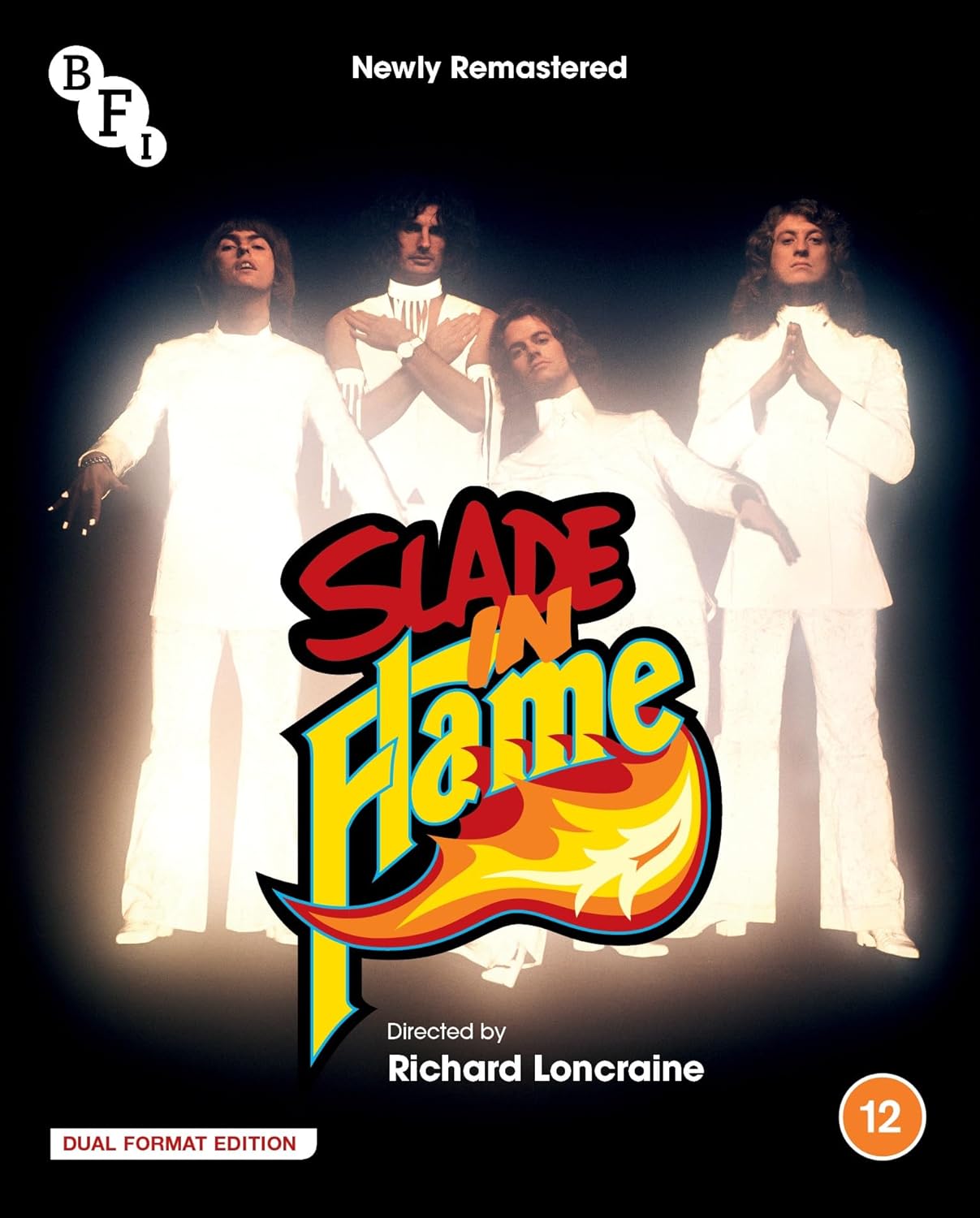
SLADE IN FLAME, Richard Loncraine, director/BFI
The BFI says: ‘Described as ‘The Citizen Kane of British pop movies’ by critic Mark Kermode, Slade in Flame both confounded and delighted audiences when it was released in 1975, at the height of the legendary glam-rock band’s success. Starring the band themselves, this was a music film like no other. In celebration of its 50th Anniversary, Slade in Flame has been remastered by the BFI for release on Blu-ray (for the first time) and DVD in a Dual Format Edition pack. Extras include a newly recorded audio commentary by director Richard Loncraine and film critic Mark Kermode and a newly filmed interview with actor Tom Conti, plus lots more. Charting the rise and fall of a pop group – from bold beginnings in seedy clubs to booze-addled endings in spectacular stadiums – this darkly cynical, warts-and-all portrait of a band in freefall amid the music industry suits who want a piece of the pie, was not what anybody was expecting. Acclaimed as a stone-cold, bona fide cult classic over subsequent decades, Slade in Flame boasts a razor-sharp screenplay, superb performances and a power-packed, foot-stomping soundtrack. Newly remastered and approved by director Richard Loncraine, an Illustrated booklet with new writing on the film by Graham Rinaldi, other essays by JT Rathbone and Barry Forshaw, notes on the special features and credits’
BEHOLD A PALE HORSE, Fred Zinneman, director/Indicator
Fred Zinneman’s drama, adapted by JP Miller from a novel by Michael Powell’s collaborator Emeric Pressburger, is a powerful piece about the final days in the life of an exiled Spanish guerrilla leader, 20 years after the Civil War. The title refers to the biblical phrase: ‘Behold a pale horse: and his name that sat on him was death’. Gregory Peck delivers a performance some distance from his customary heroic mien, but it’s certainly one of his most indelible. The subject of Zinneman’s film is free will. Impressive support from the always reliable Anthony Quinn as the police chief Vinolaas, the Peck character’s nemesis, and the acting is matched by sweepingly ambitious visuals shot on location (though not in Spain – for obvious reasons, Zinneman did not shoot the film in Franco’s Spain because of the country’s fascist past). Indicator’s transfer is truly eye-catching and a reminder of just how striking black-and-white widescreen can be when used by a master.
LITTLE MAN, WHAT NOW? Frank Borzage, director/Indicator
The reputation of the director Frank Borzage is not as well-remembered these days as it should be, but there is no denying the sheer professionalism and good taste of this highly esteemed filmmaker. Little Man, What Now remains one of his most fondly remembered films, delivered with the director’s customary skill and persuasively acted by Margaret Sullivan and Douglass Montgomery. It’s a romantic drama set in In depression-era Germany, with a couple striving to keep body and soul together – even as the husband’s boss, believing him to be single, suggests that he marry his daughter. The source novel is by Hans Fallada (now best known for the classic Alone in Berlin).
ECLIPSE, Simon Perry, director/BFI Flipside
The directorial choices that Simon Perry takes in the beguiling Eclipse are always distinguished by intelligence and a perfectly balanced filmic instinct. The effect of the film remains as subtly disturbing as when it first appeared, and it is particularly welcome to see it again in this excellent transfer from the BFI. Starring Tom Conti and Gay Hamilton, the setting for Perry’s psychological thriller is a secluded cliffside house on the Scottish coast. Tom Conti is the grieving brother living with painful memories of his twin, who he saw die at sea. When his brother’s alcoholic widow (Gay Hamilton) and her son (Gavin Wallace) arrive, dark and troubling consequences float to the surface once more. Newly remastered in 2K and presented in High Definition, Eclipse is enhanced by a lively audio commentary from Vic Pratt, co-founder of BFI Flipside and a new interview with actor Tom Conti.
THE HOUSE OF THE DEVIL, Ti West, director/Second Sight
Slowly and surely, the director Ti West has been building a reputation as one of the most reliable practitioners in the contemporary horror film, his films distinguished by a reluctance to repeat himself and a readiness to tackle unfamiliar subjects — very much the case with The House of the Devil. Ti’s film is further marked out by its unusual casting. This new Second Sight Films limited edition showcases the intriguing cast of Jocelin Donahue, cult actress Mary Woronov and Greta Gerwig, together with genre stalwarts AJ Bowen and Tom Noonan. It now receives its welcomed Limited and Standard Edition Blu-ray release. impoverished college student Samantha Hughes (Donahue), follows up on an ad for a babysitting job and persuades her friend (Gerwig) to drive her to the secluded location. The job, however, coincides with a full lunar eclipse — and truly horrific happenings ensue.
INCUBUS, John Hough, director/88 Films
Many an otherwise well-made chiller has been compromised by its bargain basement cast, but that is most definitely not the case with John Hough’s Incubus which can boast one of the most reliable actors (in fact actor/ directors) in American cinema, John Cassavetes, His presence alone would mark this out as something worthwhile – however, it’s the contribution of the director (responsible for Legend of Hell House) that makes everything work copacetically here, along with the cinematography of Albert J. Dunk (who shot the lively Class of 1984) and the composer Stanley Myers, one of the most surprisingly underrated musicians to work in film – underrated, except by directors who repeatedly turned on him to finesse their product. A sedate New England town becomes the site of a gruesome killing and assault involving a young man and his critically injured girlfriend in critical condition. Sam Cordell, head surgeon and medical examiner at the local hospital, becomes convinced that that a maniac is plying his bloody trade, A cherishable 1980s vintage flesh-creeper.
THE MAGNIFICENT CHANG CHEH, Chang Cheh, director/Eureka
In the field of filmic Chinese martial arts, it is not just the athletic stars that distinguish the best films, but the top-notch action choreographers and directors – and among the latter’s number, Chang Cheh has a reputation that is second to none. This collection (distinguished by Eureka’s customarily crisp and forensically detailed transfer) shows how the director’s mastery of editing and camera placement ensures that the pulse-raising qualities of the action scenes (along with the more relaxed exposition) are as accomplished as anything in the genre.
FOUR FLIES ON GREY VELVET/QUATTRO MOSCHE DI VELLUTO GRIGIO, Dario Argento, director/Shameless
Rock drummer Roberto, played by the American actor Michael Brandon, is stalked by a mysterious figure, who he then follows into what he thinks is an empty theatre. Roberto finds himself engaged in a fight, and stabs the assailant with his own knife. While this is happening, a masked figure has photographed the struggle, and Roberto is the victim of what appears to be a blackmailing scheme. All, of course, is not as it seems, and the murder in the theatre may not have happened at all. This was Argento’s third film in the giallo field, and it is clear that he was beginning to spread his wings in terms of reinventing a genre that had already calcified into cliché. Mmany of the Argento visual trademark flourishes are firmly in place, and the film remains essential viewing for those interested in the development of the director’s technique.
A FISTFUL OF DOLLARS, Sergio Leone, director/Arrow
Limited Edition 4K UHD and Limited Edition Blu-ray.
It wasn’t really the first film of its kind, but the western all’Italiana – or “spaghetti Western” – was never the same again after Sergio Leone’s groundbreaking film, starring Clint Eastwood in the classic role that made him an international icon. Leone’s clever and contemporary inversion of Western archetypes was not only the first entry in a much-beloved trilogy, but the director’s first collaboration with the brilliant composer Ennio Morricone. Now fully uncut and freshly restored in glorious 4K with an arsenal of new and old bonus material – as well as a poster, reversible sleeve and perfect bound collector’s booklet. To complete The Dollars Trilogy, Arrow Video will also be releasing in May and June Limited Edition 4K UHD Blu-Ray editions of both For A Few Dollars More (1965) and The Good, The Bad and The Ugly (1966).
GIRL WITH A SUITCASE, Valerio Zurlini, director/Radiance
The reputation of Valerio Zurlini’s little-seen minor classic has grown among those lucky enough to catch it, and now Radiance – as it has done so often before – grants a wider currency to the film. It’s a particularly auspicious example of post-war Italian cinema, and the 4K restoration via Cineteca di Bologna it receives here does the film singular justice. Aida (the luminous Claudia Cardinale) is in love with a wealthy playboy but find herself frozen out — except, that is, by his younger, less hardened brother, Lorenzo (played by Jacques Perrin) who aids her and falls under her spell. Cardinale is as winning as ever in Girl with a Suitcase, a coming-of-age story with a variety of narrative strands. The film was shown in competition at the 1961 Cannes Film Festival, and this disc includes archival interviews with AD Piero Schivazappa, screenwriter Piero De Bernardi and critic Bruno Torri, plus a visual essay on the film by Kat Ellinger.