

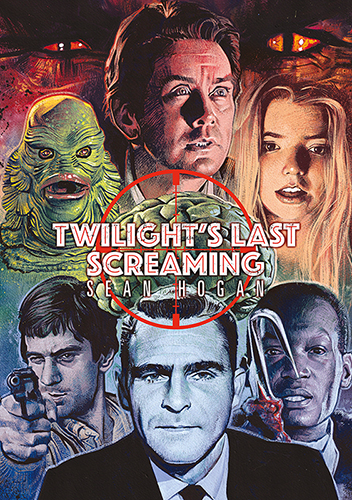
Twilight’s Last Screaming is the latest volume in my ongoing series of books of cinema metafiction. (Other titles in the sequence include England’s Screaming and Three Mothers, One Father.) A hybrid of criticism and fiction, the books are both an examination of genre cinema from the inside out, interweaving disparate characters and narratives from various films as a means of drawing connections and comparisons across decades of movies; and also a look at how genre films can provide an invaluable lens through which to perceive modern society in its entirety. So, much as England’s Screaming used British post-war horror movies to look at issues of class, culture, and country in the UK, and asked exactly what notions of Englishness might mean in an age of increasingly bitter political isolation, Twilight’s Last Screaming travels the various narrative highways and byways that have been mapped out across some eighty years of US cinema, searching for the American Dream promised to us by the movies but finding only the country’s dark heart.
In writing this series, I was heavily influenced by David Thomson’s seminal novel Suspects, and anyone familiar with that work will doubtless find echoes of it in these books, which similarly consist of a number of biographical accounts of movie characters, taking their stories far beyond the confines of the films that originally birthed them and interweaving them with other, entirely unconnected, cinematic narratives. But whereas Thomson takes film noir as his subject, I wanted to go even darker in tone, utilising horror cinema as a means of probing concepts of national identity and our collective unconscious. So many genre films can be already seen as a metaphorical exploration of the contemporary socio-political issues of their day that it seemed an entirely natural step to start connecting the theoretical dots between the various titles I selected, and in doing so, weaving blackly satirical shadow histories of the countries and societies they depicted.
That said, I also wanted to push my definition of ‘horror cinema’ far beyond its normal boundaries. Given that ‘horror’ is first and foremost an identifiable human emotion and not a genre, it seems to me that, as such, it can in fact be located in a number of wildly different areas of cinema. So in Twilight’s Last Screaming, you will find characters and references derived from not only more traditional horror films, but also noir/crime (Nightmare Alley, Detour, The Friends of Eddie Coyle), dark character dramas (Taxi Driver, Last Summer), political state of the nation movies (The Parallax View, The Candidate), and even black comedies (After Hours).
In writing Twilight’s Last Screaming, I hoped above all else to create a kind of American counter-epic, a summation of everything that these movies have meant to me and what they might yet mean for all of us. Some of these films are canonical classics, others are cult obscurities, but they all have a great deal to tell us about the increasingly parlous times we inhabit.
Pre-orders are available now:
https://blackshuckbooks.co.uk/tls/
| Twilight’s Last Screaming – Black Shuck Books
Sean Hogan is an award-nominated writer and filmmaker based in the UK. He has published several books of cinema metafiction, including England’s Screaming (named as one of the five best genre novels of the year by The Financial Times), Three Mothers, One Father, a monograph on Gary Sherman’s Death Line, and the forthcoming That Fatal Shore. His feature film credits include the critically … blackshuckbooks.co.uk |